
September 2026
Research and Policy Briefing No. 9
Martin Kemp, Family Business Research Foundation (FBRF)
Estimates apply the family-business prevalence measured in the 2018–19 Management and Wellbeing Practices Survey to ONS’s latest count of Great Britain business workplaces (March 2025), assuming that prevalence has remained broadly stable since.
Summary
Family businesses are a substantial part of the UK economy, generating £985 billion in gross value added in 2023 (Cebr and FBRF, 2025; Kemp, 2025), but national statistics rarely identify them separately, so it is hard to say how many there are. This briefing estimates how many business workplaces in Great Britain were family-business workplaces in 2025 – the workplaces of businesses that were both family-owned and family-managed – and how many people they employed. It does this by combining estimates of the prevalence of family-business workplaces from the UK government's 2018–19 Management and Wellbeing Practices (MWP) Survey with the latest available official count of business workplaces from the Office for National Statistics (ONS).
We estimate that in 2025 Great Britain had around 408,000 family-business workplaces with five or more employees [1] – 55.4% of all business workplaces of that size – employing approximately 8–9 million people. About 93% are small workplaces with fewer than 50 employees. The 408,000 estimate is a projection that applies the family-business workplace share measured in 2018–19 to the 2025 business population on the assumption that the share has remained broadly stable in the intervening period. Definitions, methodology, assumptions, sources and limitations are set out in more detail in the Appendices.
These estimates are not comparable with the figures in the State of the Nation sector report cited above: that report counts businesses of all sizes across the whole UK, including non-employing businesses and the self-employed, while this briefing counts workplaces with five or more employees in Great Britain.
Key findings
about 408,000 family-business workplaces (Great Britain, five or more employees, 2025); indicative range 386,000–430,000
55.4% of all Great Britain business workplaces with five or more employees (737,045 in total)
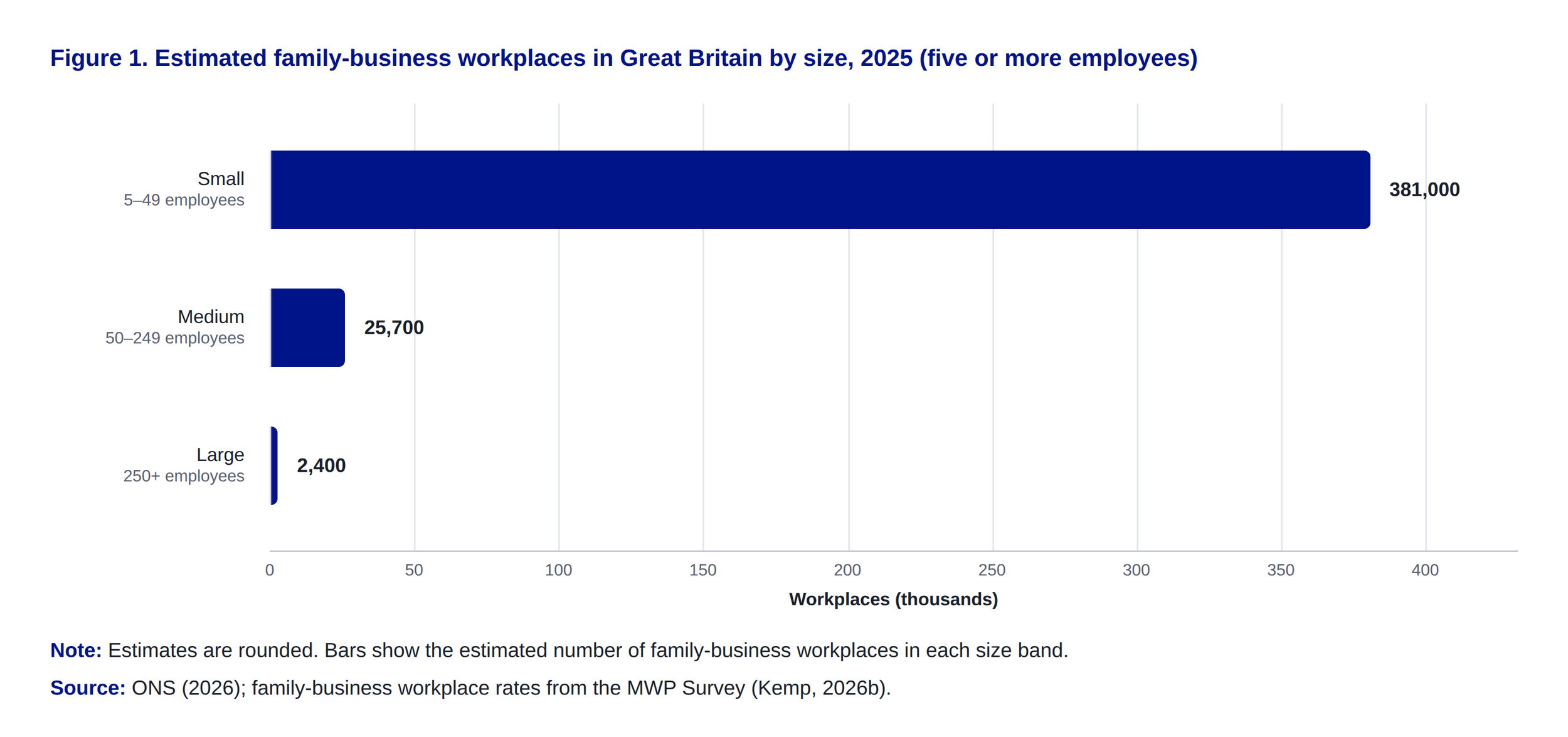
about 381,000, or 93%, are small workplaces with 5–49 employees
approximately 8–9 million employees work in family-business workplaces with five or more employees
Note: these figures count workplaces – individual sites – not businesses; one family business can run several.
1. Introduction
Family businesses make up most firms in the UK and employ millions of people (Cebr and FBRF, 2025), yet national business statistics rarely identify them as a distinct group. This briefing uses two sources of evidence to estimate the number of family-business workplaces operating in Great Britain in 2025. The first source is an analysis of the UK government's Management and Wellbeing Practices (MWP) Survey 2018–19, which estimated that 55.4% of Great Britain's private-sector business workplaces with five or more employees were family-business workplaces (Kemp, 2026b). The second source of evidence we use is a count of business workplaces in Great Britain, obtained from the Office for National Statistics through an ad hoc data request made by the FBRF (ONS, 2026).
The MWP Survey tells us the family-business workplace share; the ONS data tell us the total number of workplaces in Great Britain in 2025, their distribution by workplace size and the number of people they employ. By applying the former to the latter, it is possible to estimate the numbers of business workplaces that are owned and managed by families.
Throughout this briefing, a family-business workplace means a workplace of a business that is majority-owned by the person or family who first set it up, with members of that family actively involved in the day-to-day management of the business. The full definition, method, sources and limitations are set out in the Appendices.
2. How many family-business workplaces are there in 2025?
An ONS ad hoc data request (ONS, 2026) records 737,045 VAT- and PAYE-based private-sector business workplaces in Great Britain with five or more employees in March 2025, counted by the number of employees at the workplace – the same measure of workplace size used in the survey. Applying the 55.4% family-business workplace share measured from the MWP Survey yields an estimated 408,000 family-business workplaces in 2025 (Table 1).
| Great Britain business workplaces with five or more employees, 2025 | Number | Share |
|---|---|---|
| All private-sector business workplaces | 737,045 | 100% |
| of which: family-business workplaces (estimated) | 408,000 | 55.4% |
Source: ONS (2026), ad hoc data request 3540; family-business workplace share from the MWP Survey (Kemp, 2026b).
Note: the ONS count is control-rounded to base five. The family-business figure is an estimate, rounded to the nearest thousand.
408,000 is a best estimate, not an exact count. The 55.4% share comes from a survey of around 1,700 workplaces, so it carries a margin of error: the figure could reasonably lie anywhere between about 386,000 and 430,000, or roughly 5% either side [2]. That range reflects only the uncertainty that comes from using a survey sample. It does not allow for the possibility that the share itself has changed since 2018–19, or for the other sources of uncertainty set out in Appendix C.
Because the share was measured in 2018–19, the estimate also assumes it has not changed materially since then. The best available check, the Longitudinal Small Business Survey, suggests the picture has been broadly stable, although it measures something slightly different. Appendix B sets out that evidence and its limits.
3. Family-business workplaces by size
Family-business workplaces are not spread evenly across the size range, so it helps to break the estimate down by size. They are overwhelmingly small: about 93% have fewer than 50 employees, and only about 2,400 have 250 or more. Applying the survey's size-specific rates to the 2025 workplace counts gives the following.
| Workplace size | Family-business workplace rate | All workplaces | Estimated family-business workplaces |
|---|---|---|---|
| Small (5–49) | 56.9% | 669,650 | 381,000 |
| Medium (50–249) | 43.8% | 58,680 | 25,700 |
| Large (250+) | 27.6% | 8,715 | 2,400 |
| All sizes (five or more) | 55.5% | 737,045 | 409,000 |
Source: ONS (2026), ad hoc data request 3540; size-specific rates from the MWP Survey (Kemp, 2026b).
Note: the family-business workplace figures are estimates and have been rounded. The size-based total (409,000) is close to the headline estimate (408,000) because the two use different methods: the headline applies one overall rate to the total, while this table applies three size-specific rates to the 2025 size distribution. The small difference reflects both that difference in method and the rounding of the rates.
4. How many people do they employ?
The MWP Survey recorded the size of each workplace as its number of employees – a headcount of people on the payroll, rather than full-time-equivalent posts (DBT, 2023b; Kantar Public, 2018). On that basis, it has been estimated that there were an average of 25 employees per business workplace – 21 in family-business workplaces and 29 in non-family business workplaces (Kemp, 2026b). Multiplying these averages by the 2025 workplace counts gives a broad estimate of employment.
| Group | Workplaces | Mean employees | Estimated employees |
|---|---|---|---|
| Family-business workplaces | 408,000 | 21 | about 8.6 million |
| Non-family business workplaces | 329,000 | 29 | about 9.5 million |
| All workplaces (five or more) | 737,045 | 25 | about 18 million |
Source: 2025 workplace counts from ONS (2026); average workplace sizes from the MWP Survey 2018–19 (Kemp, 2026b).
Note: These figures show the general scale rather than precise numbers. They are not a measure of total employment in the economy: they cover only business workplaces in Great Britain with five or more employees. The 18 million is the two groups added together. The average of 25 is what those two averages work out to overall, so multiplying 737,045 by 25 does not give exactly the same answer. The survey reported the averages as whole numbers and did not publish how precise they are. The total is less sensitive to the uncertainty in these estimates than the two group figures are, because those two move in opposite directions.
These estimates show two patterns. First, whilst family-business workplaces are in the majority (about 408,000 of 737,045, or 55.4%), they are smaller on average, so they account for a smaller share of employment than of workplaces – on the central estimate, a little under half, or 8–9 million of the roughly 18 million people employed in business workplaces of this size. In short, family-business workplaces are more numerous, but because they are smaller on average, they employ somewhat fewer people overall than non-family business workplaces.
Second, the employment figures are less certain than the workplace counts. They use the average workplace sizes measured in 2018–19 and assume workplaces are still, on average, the same size. That is a second assumption, on top of the assumption that the family-business workplace share has held steady. Average workforce sizes may well have changed since 2018–19, not least during the Covid-19 pandemic, and this briefing does not attempt to update them: no single source currently gives both the number of employees at each workplace and a reliable way of identifying family businesses. The employment figures are therefore best read as an indication of scale rather than precise counts.
These results are consistent with the FBRF's latest family-business sector report (Cebr and FBRF, 2025), which found a similar pattern: family businesses are more numerous, but they also tend to be smaller, with family ownership concentrated among smaller firms and least common among the largest. On the report's figures, once businesses with no employees are set aside – firms where the only people working in them are the owners – family businesses employ no more people overall than non-family businesses. One important caveat: the figures in the sector report are not directly comparable with those presented here. Cebr's analysis was enterprise-based rather than workplace-based, covered the whole UK rather than Great Britain, included firms of all sizes, and related to 2023 to 2024. The two therefore measure different things, even though they point in the same direction.
Appendices
Appendix A. Definitions, methodology and sources
Definitions. A family-business workplace is a workplace of a business that is majority-owned by the person or family who first set it up, with members of that family actively involved in the day-to-day management of the business. This owned-and-managed definition, used in the working paper, is deliberately rigorous: a workplace counts as a family-business workplace only where the family both owns and actively runs the business. It therefore excludes family- or founder-owned firms run by outside managers.
Requiring both conditions is deliberate, and it is what makes this a measure of family business rather than of founder ownership. The MWP Survey asked whether the business is majority-owned by the person ‘or family’ who first set it up. Because that question covers both, taken on its own it would also count a business run by one person; the second question then asks whether any of that family are actively involved in the day-to-day management of the business. Because this second question refers to “the family” and not to the founder, it resolves that ambiguity and confirms that a family, rather than a single individual, is involved in running the business. Its role is to confirm what kind of business is being observed, not to narrow the definition.
Requiring both also corresponds more closely to the European Commission's definition, which requires both family ownership of decision-making rights and family involvement in the firm (European Commission, 2009) – although day-to-day management is not the same thing as formal governance, and the MWP Survey did not ask about governance directly (Kemp, 2026b).
A workplace is a local unit – an individual site – so a single business may operate more than one. Workplace size is measured as the number of employees (a headcount of people on the payroll, not full-time-equivalent posts). The ONS extract is compiled on the same stated basis, counting employees at the local unit rather than the wider ‘employment’ measure that also includes working proprietors. The estimate covers private-sector businesses (companies, sole traders and partnerships) in Great Britain with five or more employees.
Methodology. The estimate is a simple, transparent calculation: family-business workplaces = 55.4% × the ONS count of business workplaces with five or more employees (737,045), giving about 408,000; applying the survey's size-specific rates gives a similar total (409,000). Employment is estimated by multiplying the workplace counts by the survey's average workplace sizes (25 overall; 21 for family-business and 29 for non-family business workplaces). The ONS base was chosen for two reasons: it counts workplaces by employees at the site, not the wider ‘employment’ measure that also counts working proprietors, so it matches the survey's five-employee threshold; and ONS defines the extract's scope as private-sector businesses (companies, sole traders and partnerships), the same population covered by the survey analysis. The 55.4% is a survey estimate and carries an indicative sampling range of about ±5% (see note 2). A fuller account, including a consistency check against the survey's own weighted population, is set out in an FBRF methodology note available from FBRF on request.
Sources. Family-business workplace rates and average workplace sizes: FBRF's analysis of the MWP Survey 2018–19 (Kemp, 2026b), based on the survey conducted by the National Institute of Economic and Social Research and Kantar (DBT, 2023a) and documented in the survey technical report (DBT, 2023b). Business-workplace counts: ONS ad hoc data request 3540 (ONS, 2026). Trend evidence: the Longitudinal Small Business Survey (DBT, 2025; Kemp, 2024, 2026a). Wider sector context: the State of the Nation report (Cebr and FBRF, 2025).
Appendix B. Has the family-business workplace share changed since 2018–19?
The estimate uses the family-business workplace share measured in 2018–19, so it is worth asking whether that share is likely still to hold. The main check available derives from analysis of data from the Longitudinal Small Business Survey (LSBS) which identifies family ownership among small and medium-sized enterprise (SME) employers each year. That rate rose from 74% in 2019 to a peak of 80% in 2021, then eased back to 73% by 2024 (DBT, 2025; Kemp, 2024, 2026a). This represents fluctuation around a broadly stable level rather than a sustained trend; by 2024, the rate was close to its 2019 starting point.
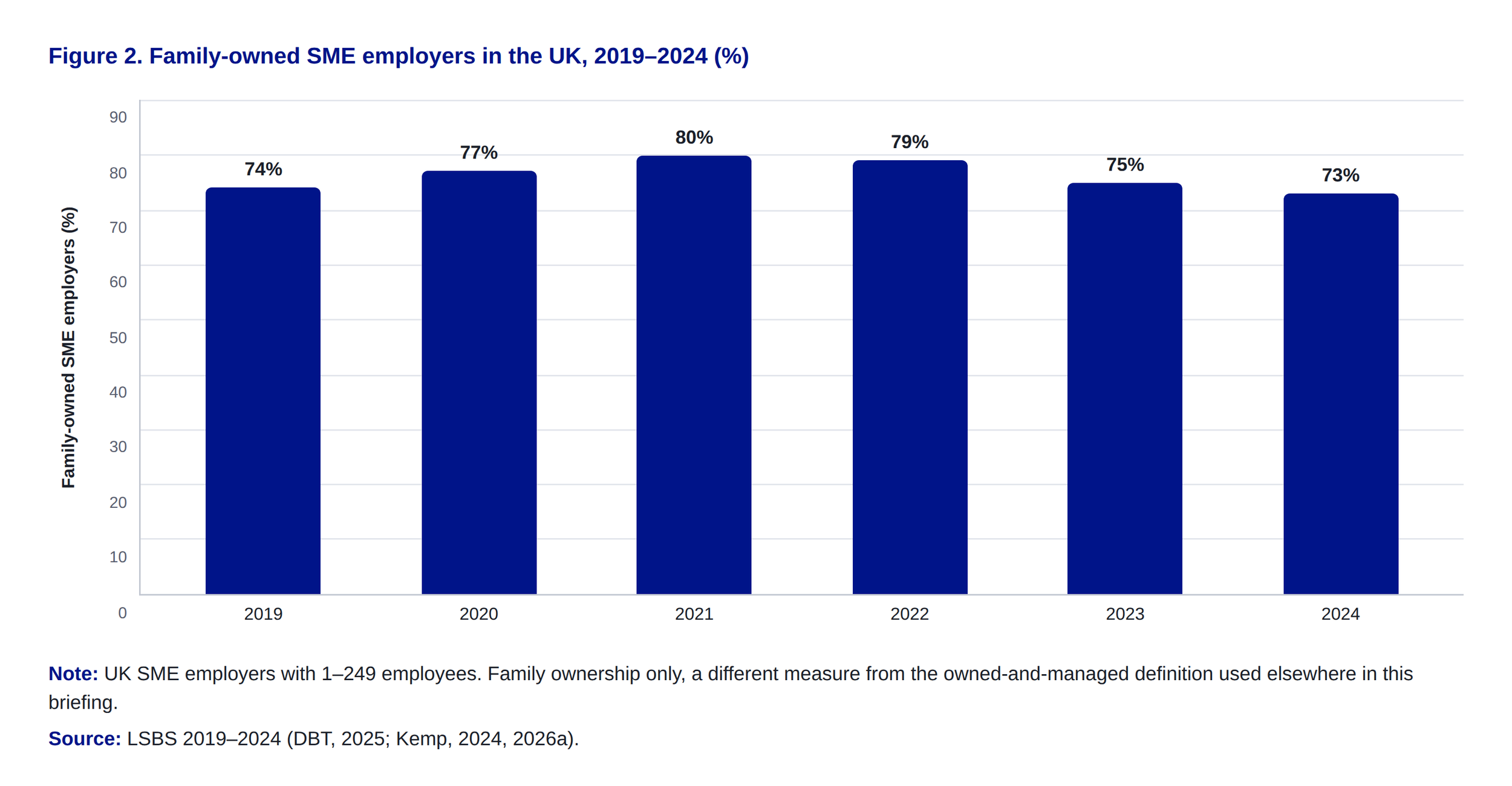
This is an indirect, contextual check rather than a validation. The LSBS differs from the MWP Survey in unit (enterprises, not workplaces), size range (1–249 employees), geography (the UK, not Great Britain) and definition (family ownership, rather than ownership combined with management), and it treats single-owner enterprises as family-owned by default. It is therefore consistent with the 2018–19 share having remained broadly stable, but it cannot confirm whether the MWP measure itself remained stable, particularly for large workplaces. The stability assumption is listed among the limitations below.
Appendix C. Assumptions and limitations
An assumption-based projection: It applies a 2018–19 rate to a 2025 population and assumes the family-business workplace share has been broadly stable; the evidence and its limits are set out above.
Sampling range covers one source of uncertainty only: The indicative range of about 386,000–430,000 (±5%) reflects sampling error in the measured share. It does not cover the projection assumption, classification missingness, survey non-response or the definitional differences noted below, so the true uncertainty is wider. See note 2.
Classification of cases with missing data: The working paper analysed 1,856 private-sector business workplaces, but only 1,694 (91.3%) could be classified as family or non-family; the remaining 162 lacked the necessary answers. Applying the rate from classified cases to the whole population assumes those missing cases would have divided in a similar way, which cannot be tested here.
Employment figures are indicative: They multiply 2025 workplace counts by 2018–19 average workplace sizes (25 overall; 21 family, 29 non-family), which are assumed to remain applicable. Average workforce sizes may have changed since 2018–19, and are not re-measured here, so these figures are order-of-magnitude only.
Five or more employees only: This is not a count of all family-business workplaces – it excludes the much larger number with fewer than five employees, so an all-sizes total would be considerably higher.
Great Britain only: The survey covers Great Britain, so no UK-wide figure is given.
Comparisons with wider statistics: The FBRF’s State of the Nation figures count enterprises of all sizes across the whole UK – including non-employing businesses and the self-employed – and relate to 2023; this estimate counts workplaces with five or more employees in Great Britain, excluding Northern Ireland, in 2025. These are different populations, not the same population measured differently. The two are not directly comparable and no numerical bridge between them is offered here; the comparison in section 4 is limited to the pattern both find. Breakdowns by size are especially not comparable, because one large business can comprise many small workplaces.
Definition: The estimate uses the stricter owned-and-managed definition set out above. Because it excludes family-owned businesses that are run by professional managers, it errs towards under-counting; a looser ‘family-owned only’ count would give a higher figure.
Notes
These figures count workplaces – individual sites – not businesses; one family business can run several, so there are fewer family businesses than family-business workplaces.
The range is derived from the size of the MWP sample used to estimate the family-business workplace rate (around 1,700 classified workplaces), adjusted for the survey's weighting design effect. On a simple random sample, the 95% interval would be about ±2.4 percentage points; the survey's reported weighting efficiency of about 58% implies a design factor of roughly 1.3, giving about ±3 percentage points on the 55.4% rate. Applied to the base of 737,045 business workplaces, that is about ±22,000 workplaces (roughly ±5% of the estimated count), or a range of about 386,000–430,000. The range is indicative rather than a design-based confidence interval: the sampling variance for this specific estimate is not published, and the survey's sampling and weighting are documented in the technical report (DBT, 2023b). It reflects sampling uncertainty in the measured rate only.
References
Cebr and Family Business Research Foundation (FBRF) (2025). The State of the Nation: The UK Family Business Sector in 2023. London: FBRF. Available at: https://www.fbrf.org.uk/reports/state-of-the-nation-23 (Accessed: 28 July 2026).
Department for Business and Trade (DBT) (2023a). Findings from the Management and Wellbeing Practices Survey. London: DBT. Available at: https://niesr.ac.uk/wp-content/uploads/2023/06/Findings-from-the-Management-and-Wellbeing-Practices-Survey-1.pdf (Accessed: 28 July 2026).
Department for Business and Trade (DBT) (2023b). The Management and Wellbeing Practices Survey 2018: Technical Report. London: DBT (UK Data Service, SN 9253). Available at: https://doc.ukdataservice.ac.uk/doc/9253/mrdoc/pdf/9253_mwp_technical_report_final_clean_external.pdf (Accessed: 28 July 2026).
Department for Business and Trade (DBT) (2025). Small Business Survey 2024: businesses with employees. London: DBT. Available at: https://www.gov.uk/government/statistics/small-business-survey-2024-businesses-with-employees (Accessed: 28 July 2026).
European Commission (2009). Overview of family-business-relevant issues: research, networks, policy measures and existing studies. Final report of the Expert Group. Brussels: European Commission. Available at: https://webgate.ec.europa.eu/circabc-ewpp/rest/download/b93a59c5-1961-4a01-9fea-bb25def5aa91 (Accessed: 28 July 2026).
Kantar Public (2018). BEIS Management and Wellbeing Practices Survey 2018: questionnaire (mainstage version, 24 September). Available at: https://www.niesr.ac.uk/wp-content/uploads/2023/07/MWP-Appendix-A-Questionnaire.pdf (Accessed: 29 July 2026).
Kemp, M. (2024). How common are family businesses in the UK? Latest evidence from the 2023 Small Business Survey. London: FBRF. Available at: https://www.fbrf.org.uk/how-common-are-family-firms (Accessed: 28 July 2026).
Kemp, M. (2025). New evidence on the economic impact of family firms. London: FBRF. Available at: https://www.fbrf.org.uk/news/family-business-contribution-to-the-uk-economy-in-2023 (Accessed: 20 August 2026).
Kemp, M. (2026a). Family SMEs in the UK: Latest findings from the Small Business Survey 2024. London: FBRF. Available at: https://www.fbrf.org.uk/familysmes-2024 (Accessed: 28 July 2026).
Kemp, M. (2026b). Management and wellbeing practices in family-business workplaces in Britain. London: FBRF. Available at: https://www.fbrf.org.uk/reports/family-business-workplaces-in-britain (Accessed: 28 July 2026).
Office for National Statistics (ONS) (2026). Local units in Great Britain by section and size: March 2025. Ad hoc data request, reference 3540, produced from the Inter-Departmental Business Register (IDBR); data as at March 2025. Newport: ONS. Available at: https://www.ons.gov.uk/businessindustryandtrade/business/activitysizeandlocation/adhocs/3540localunitsingreatbritainbysectionandsizemarch2025. Data file used: ah1873p.xlsx, available at https://www.ons.gov.uk/file?uri=/businessindustryandtrade/business/activitysizeandlocation/adhocs/3540localunitsingreatbritainbysectionandsizemarch2025/ah1873p.xlsx (Accessed: 28 July 2026).