
Management and Wellbeing Practices in Family-business Workplaces in Britain
July 2026
Research and Policy Briefing No.8
Martin Kemp, Family Business Research Foundation
Summary
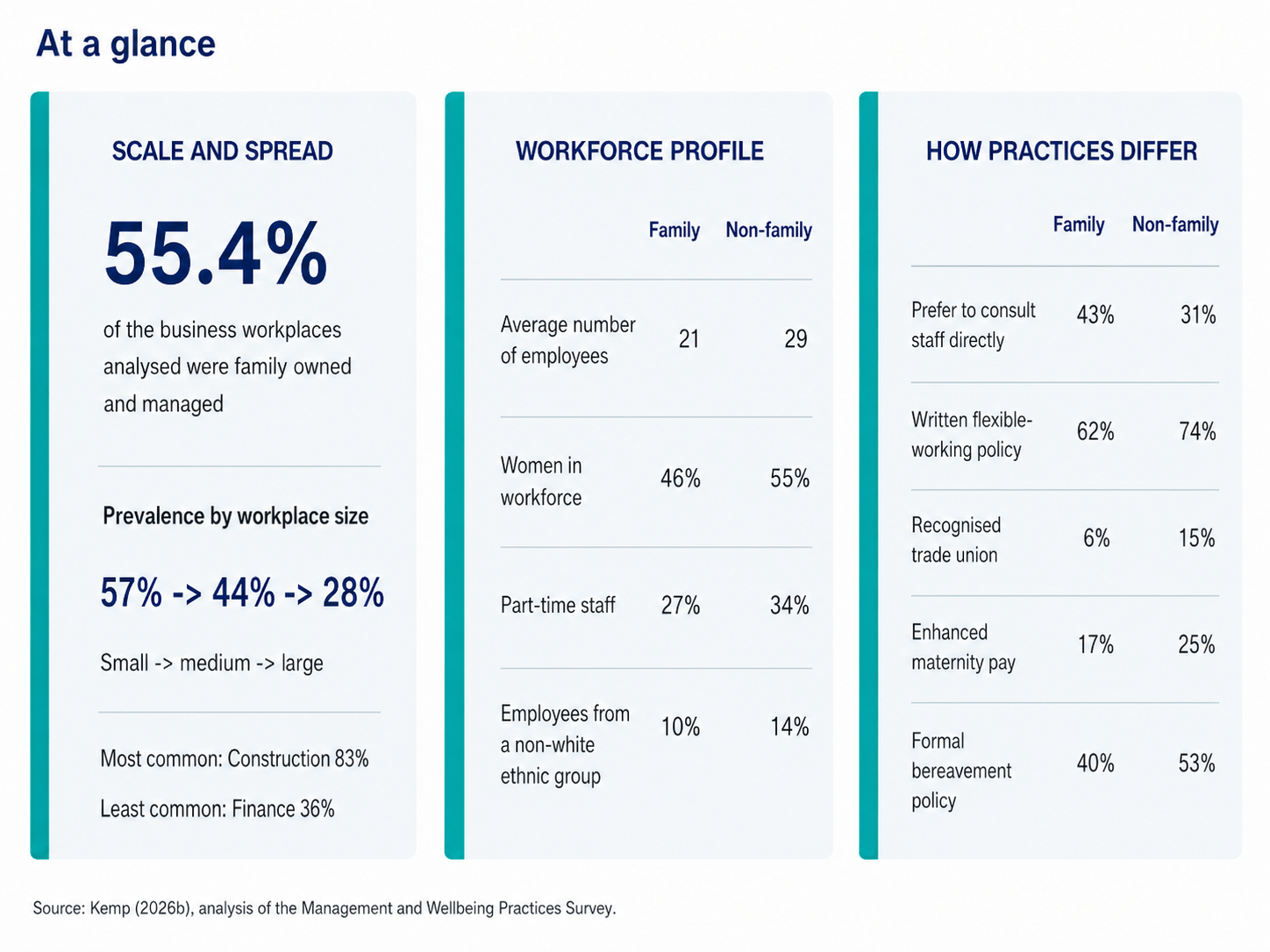
Family businesses are a large part of the British economy, yet national surveys rarely identify them or make it possible to compare them with other firms. This briefing summarises new analysis of the Department for Business and Trade's (DBT) 2018–19 Management and Wellbeing Practices Survey, comparing family-business workplaces with non-family business workplaces in Great Britain (Kemp, 2026b). The clearest difference was not whether family-business workplaces supported their staff, but how: they were consistently less likely to rely on written policies, formal consultation and recognised trade unions - and much of this gap remained even when workplaces of the same size were compared.
This study sits within FBRF's effects-based research framework, which examines how family ownership and management affect businesses, families and wider society (Family Business Research Foundation, 2026; Kemp, 2026a). It contributes to that framework by focusing on internal business effects: how family ownership and management are associated with workplace management and wellbeing practices, employment relations and employee policies.
1. About the study
The Management and Wellbeing Practices Survey was commissioned by the UK government and carried out in 2018–19 by the National Institute of Economic and Social Research and Kantar Public (DBT, 2023a). It is a nationally representative survey of workplaces with five or more employees in Great Britain - that is, England, Scotland and Wales; Northern Ireland is not covered, so this briefing refers to Britain rather than the UK throughout. This briefing draws on analysis of around 1,700 private-sector business workplaces, classified by whether they belonged to a business that was both founder- or family-owned and founder- or family-managed (Kemp, 2026b). The survey looks at individual workplaces rather than whole firms, and provides a valuable pre-pandemic, pre-reform benchmark of how employers organised people management (DBT, 2023a, 2023b).
2. How common are family-business workplaces - and where?
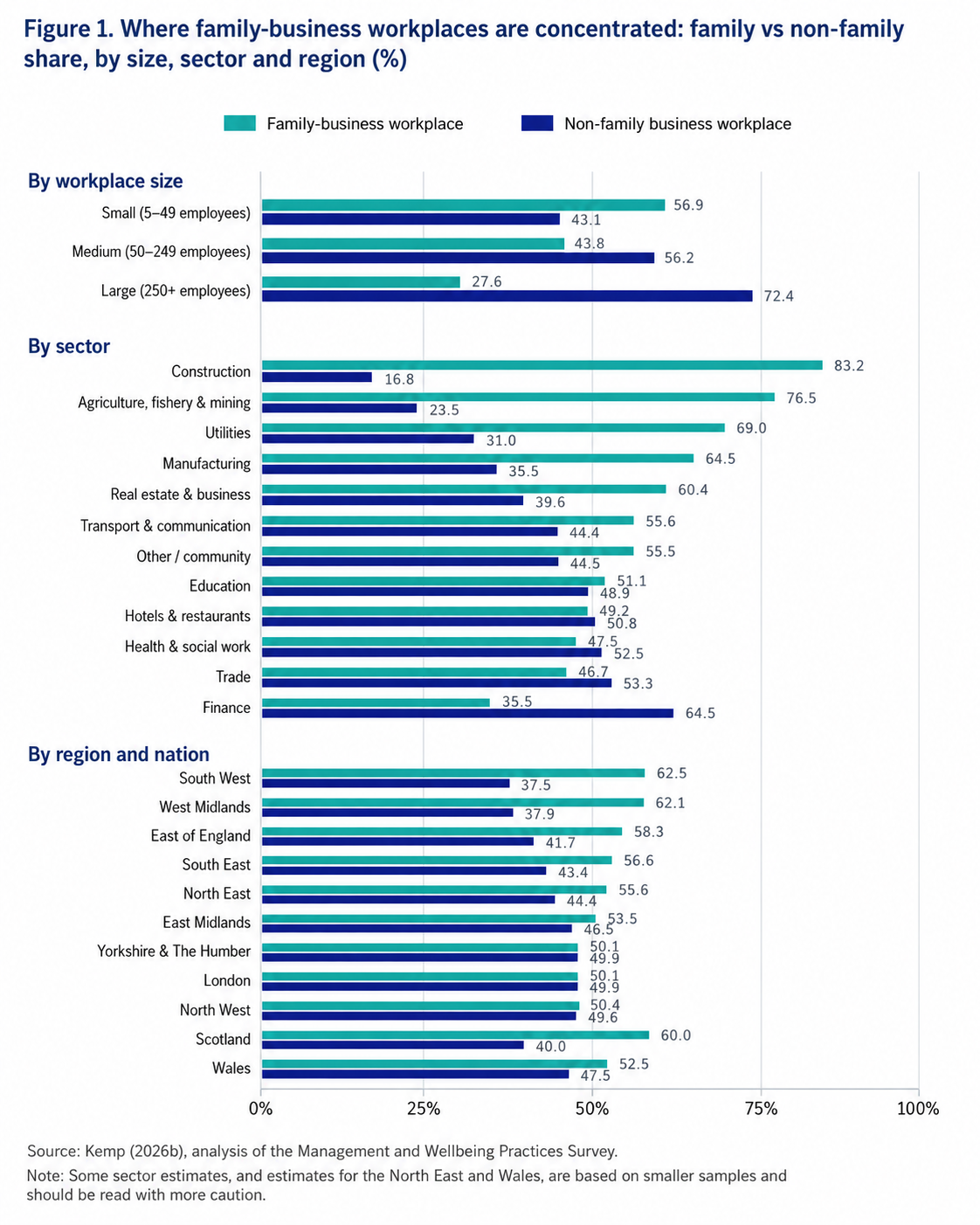
Family-business workplaces were a major part of the business workplace population, making up 55.4 per cent of those analysed - a slight majority, not a niche group. But they were unevenly spread (Figure 1). Their share fell sharply with size, from 57 per cent of small workplaces (under 50 staff) to 44 per cent of medium and 28 per cent of large ones - and from around two-thirds of the smallest organisations to fewer than one in ten of the very largest. They were also concentrated by sector, highest in construction (83 per cent), agriculture, fishery and mining (77 per cent) and manufacturing (65 per cent), and lowest in finance (36 per cent) and trade (47 per cent). Regional differences were more modest, though family-business workplaces were somewhat more prevalent in the South West, West Midlands and Scotland (60-63 per cent) and least so in London and the North West (around 50 per cent). Figure 1 sets out the full picture by size, sector and region.
3. They are structurally different
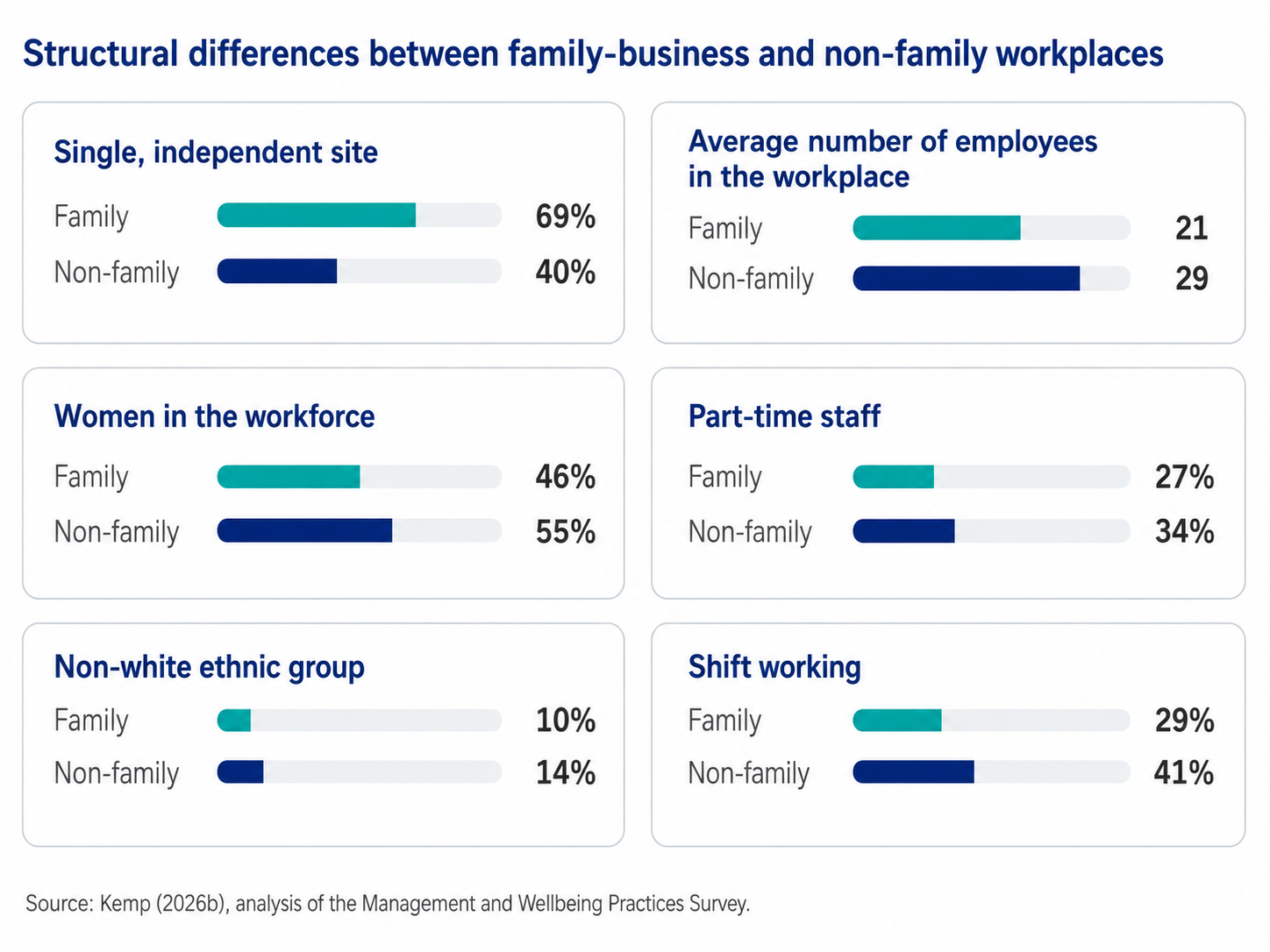
Family-business workplaces were not simply non-family workplaces under a different ownership label. The tiles below compare the two groups across six structural features drawn from the survey, and show that family-business workplaces tended to be smaller and simpler in form. They were more likely to be single, independent sites rather than part of a larger organisation, and smaller on average - 21 employees, compared with 29 in non-family workplaces.
They also employed lower shares of women, part-time staff and employees from a non-white ethnic group, and were less likely to run shift working. These structural differences matter because they could help explain some of the differences in practice - which is why the analysis goes on to compare like-sized workplaces directly.
4. Managed differently, not necessarily less supportively
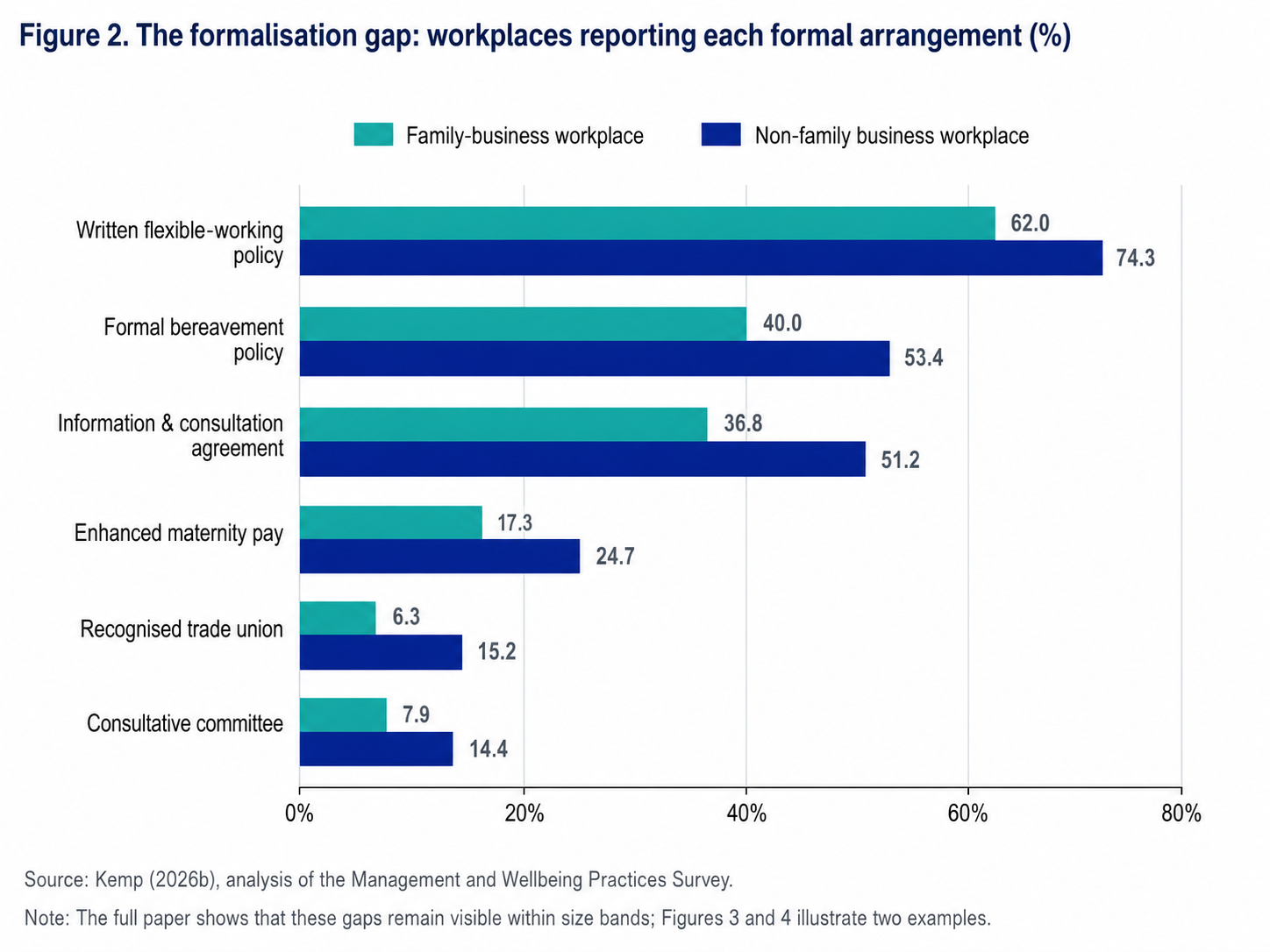
The clearest difference was in how workplaces were run, not whether support for staff existed. The evidence is consistent with family-business workplaces relying more on direct, less formalised ways of managing people, and less on written policies and formal structures. Across a consistent set of measures (Figure 2), they were less likely than non-family workplaces to report a written flexible-working policy, a consultative committee, a formal information-and-consultation agreement, a recognised trade union, enhanced maternity pay, or a formal bereavement policy. They were also more likely to offer none of the listed forms of childcare support (61 per cent against 48 per cent).
5. It is not simply because family-business workplaces are smaller
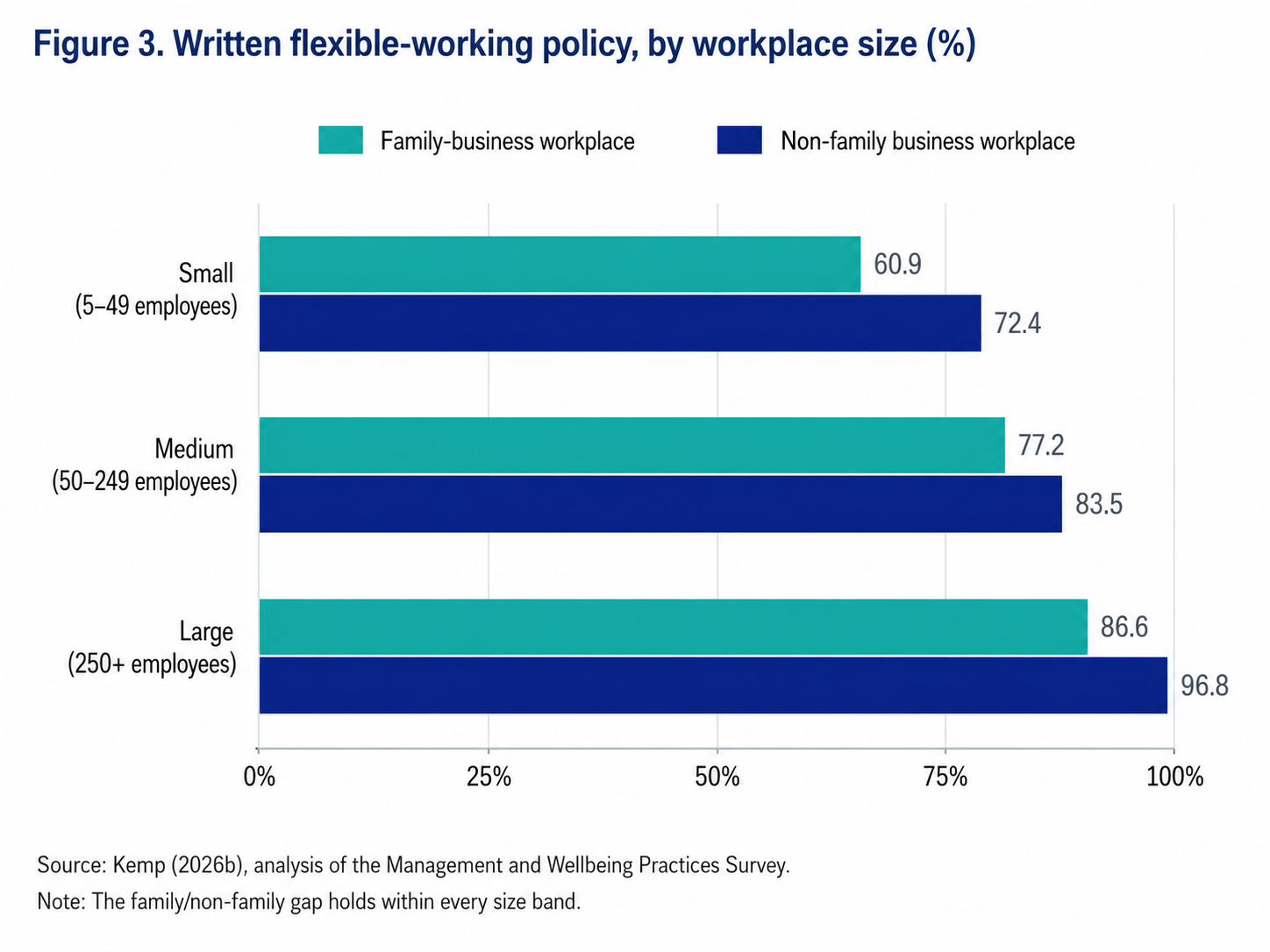
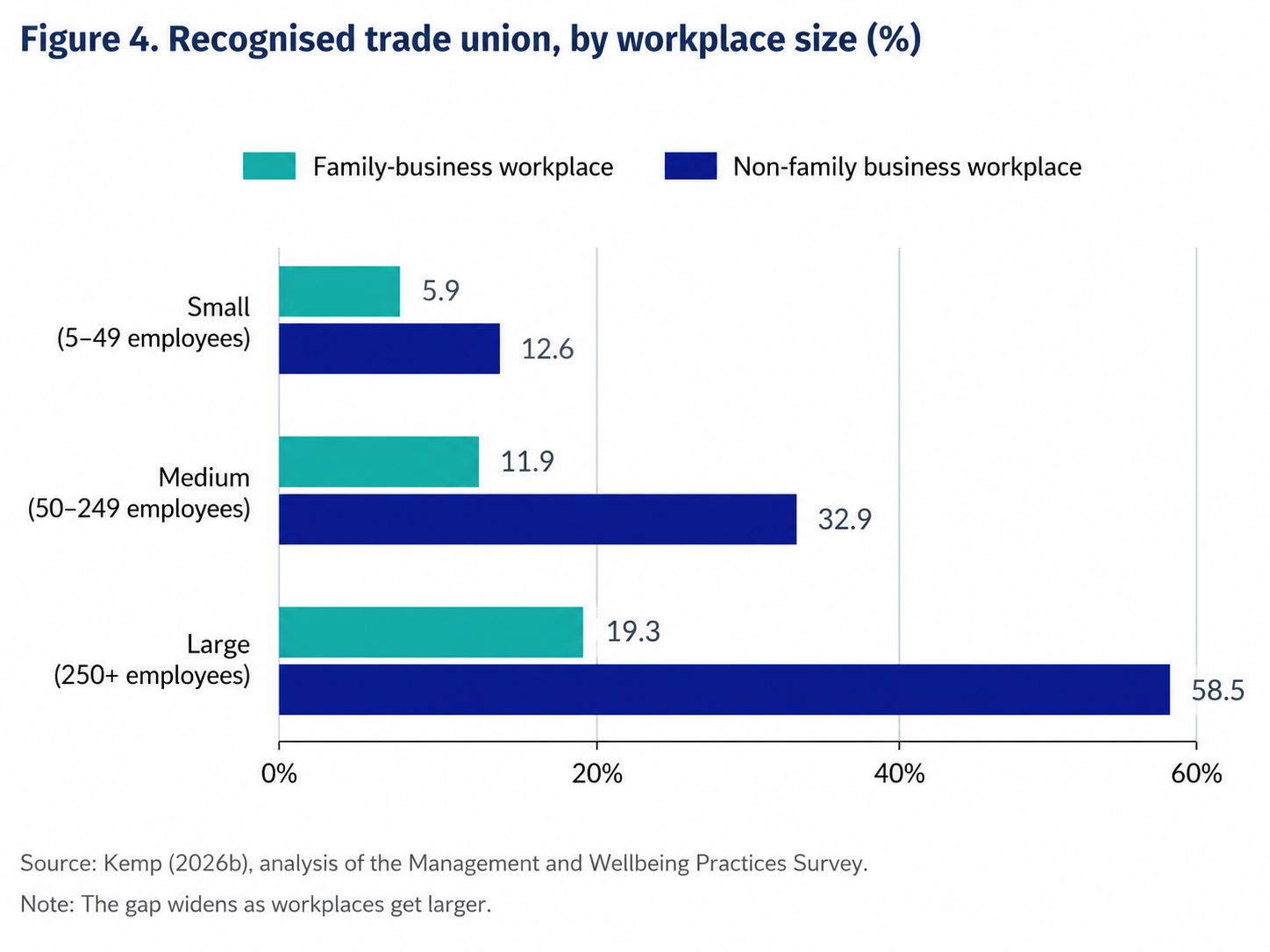
Because family-business workplaces tended to be smaller, it would be easy to assume these gaps just reflected size. They did not. For several of the most important measures, the gap remained when family and non-family workplaces of the same size were compared. Figures 3 and 4 show two examples: a written flexible-working policy, where family workplaces trailed within every size band; and recognised trade unions, where the gap was widest among medium-sized and larger workplaces. Smaller workplaces of every kind leaned towards informal working; family ownership added a further layer on top of that, pointing to family ownership and management, and not size alone, shaping how these workplaces operated.
6. Less formal does not necessarily mean less supportive
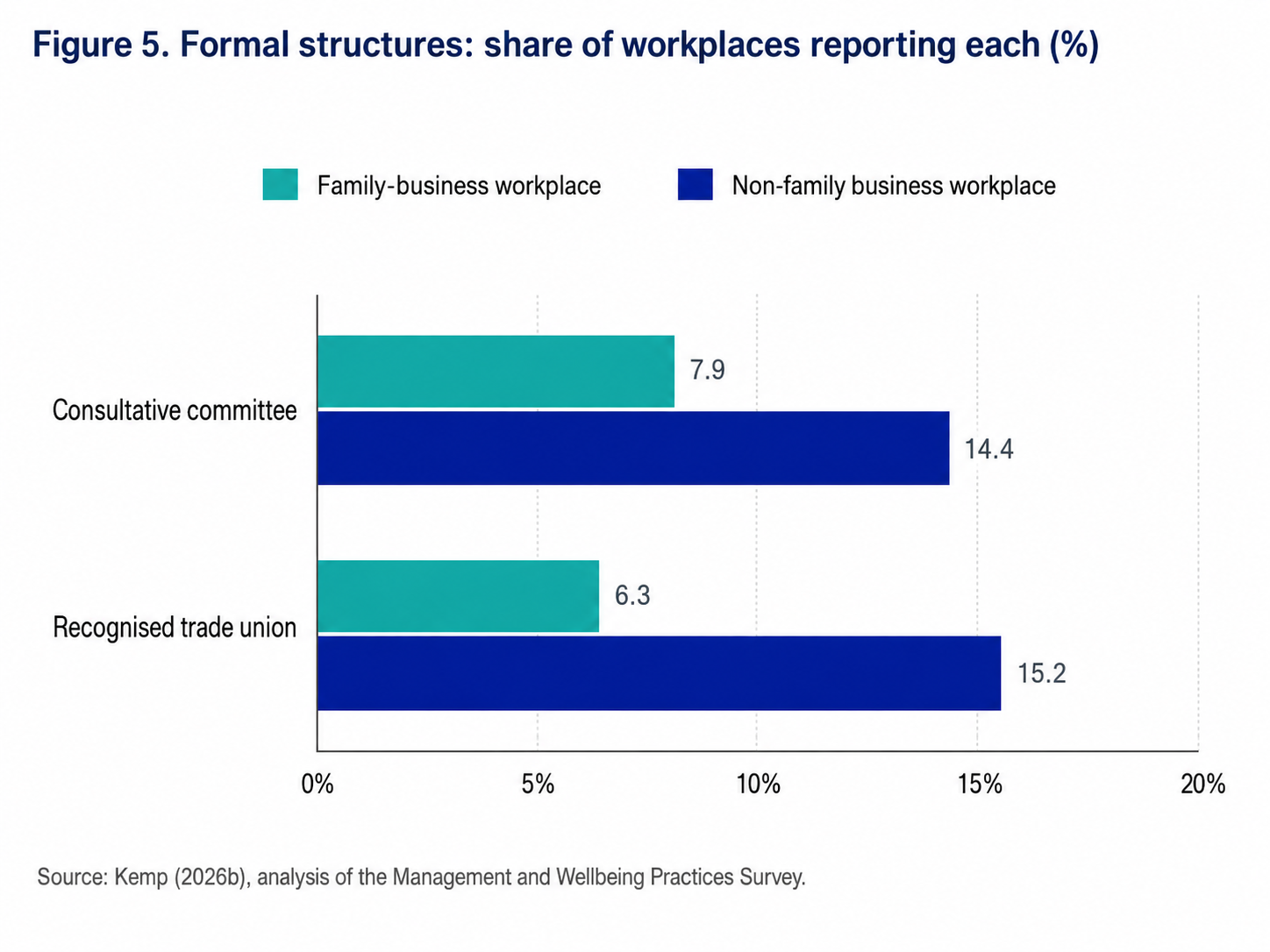
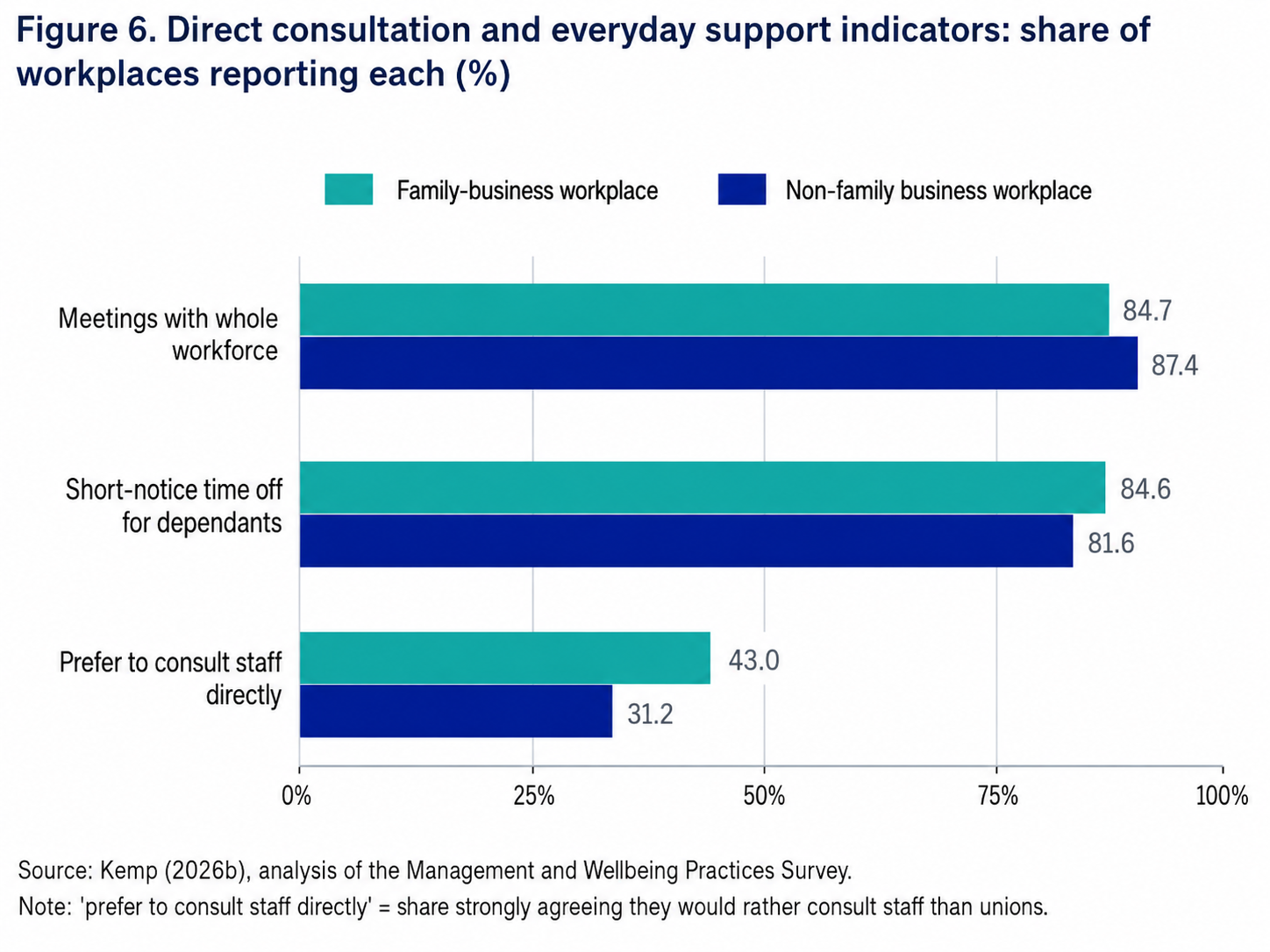
Lower formalisation should not be read as weaker support. Figures 5 and 6 set out the contrast. On formal structures - consultative committees and recognised unions - family-business workplaces were clearly behind (Figure 5). But on direct consultation and everyday support indicators, they were level or ahead (Figure 6): regular meetings between managers and staff were common in both groups, family-business employers more often expressed a preference for consulting staff directly, and some everyday provisions, such as short-notice time off to care for a dependant, were similar across the two. This suggests family-business workplaces tend to handle support and consultation through more direct and less formal channels rather than through written policy alone, not that they support their staff any less.
7. Implications for policy, research and practice
For family-business owners and managers
Informal, relationship-based ways of managing people can work well while owners and staff know each other well. But they can come under strain as a business grows, adds management layers, or the founding family steps back from day-to-day management. Earlier research likewise found that family businesses tended to have fewer formal human resources (HR) practices and were less likely to have an HR strategy (Bacon, Hoque and Siebert, 2013). Owners and their advisers should check that key areas - flexible working, consultation, and bereavement and family support - are clear, consistent and documented, so the strengths of direct management are preserved as the firm grows.
For policymakers
New employment rights only work in practice if they are clearly communicated and consistently applied - and how far that happens varies with the kind of business. Smaller workplaces are generally less likely to manage people through written policies and formal systems, and family-business workplaces less likely still, across all size groups. Because such firms make up a large part of the business population, guidance and support are likely to be more effective when designed around how these businesses actually operate, rather than assuming every employer runs things through formal HR systems.
For research
Acting on these findings depends on better evidence. Britain lacks a workplace survey on the scale of the Workplace Employment Relations Study (WERS), last conducted in 2011, and lacks consistent ways of identifying family firms in national data (Kemp, 2026b). Three priorities follow: building robust family-business identifiers into major surveys; developing a credible successor to WERS, potentially using linked employer-employee records (Forth, Bryson and Palmou, 2025); and using the 2018–19 survey as a baseline to assess whether lower formalisation among family-business workplaces persists following the 2024 flexible-working reforms and the current phase of employment-rights reform.
Based on the FBRF working paper Management and wellbeing practices in family-business workplaces in Britain (Kemp, 2026b). The full paper and complete references are available at https://www.fbrf.org.uk/reports/family-business-workplaces-in-britain
References
Bacon, N., Hoque, K. and Siebert, S. (2013) Family Business People Capital. London: IFB Research Foundation. Available at: https://www.bayes.citystgeorges.ac.uk/__data/assets/pdf_file/0014/180050/People-Capital.pdf
Department for Business and Trade (DBT) (2023a) Findings from the Management and Wellbeing Practices Survey. London: Department for Business and Trade. Available at: https://niesr.ac.uk/wp-content/uploads/2023/06/Findings-from-the-Management-and-Wellbeing-Practices-Survey-1.pdf
Department for Business and Trade (DBT) (2023b) Management and Wellbeing Practices Survey 2018: Technical Report. London: Department for Business and Trade. Available at: https://doc.ukdataservice.ac.uk/doc/9253/mrdoc/pdf/9253_mwp_technical_report_final_clean_external.pdf
Family Business Research Foundation (2026) Research framework. Available at: https://www.fbrf.org.uk/research-framework
Forth, J., Bryson, A. and Palmou, C. (2025) A Roadmap for Developing a New Linked Employer-Employee Data Infrastructure. ESCoE Technical Report TR-28. Available at: https://www.escoe.ac.uk/publications/a-roadmap-for-developing-a-new-linked-employer-employee-data-infrastructure/
Kemp, M. (2026a) The Effects of Family Ownership: an Integrated Framework for Research and Practice. FBRF Research and Policy Briefing No. 7. Available at: https://www.fbrf.org.uk/research-briefings/the-effects-of-family-ownership-an-integrated-approach
Kemp, M. (2026b) Management and wellbeing practices in family-business workplaces in Britain. An FBRF Working Paper. London: Family Business Research Foundation. Available at: https://www.fbrf.org.uk/reports/family-business-workplaces-in-britain