
Britain has around 423,000 family owned and managed workplaces - why that matters
By Martin Kemp, Family Business Research Foundation
July 2026
Family businesses are one of the largest - and least visible - parts of the British economy. They rarely show up as a distinct group in official statistics, which makes it hard to say how many there are or where they are. Drawing on new FBRF research, this piece offers an up-to-date estimate for one important slice of the economy: the workplaces where people are employed, managed and supported day to day.
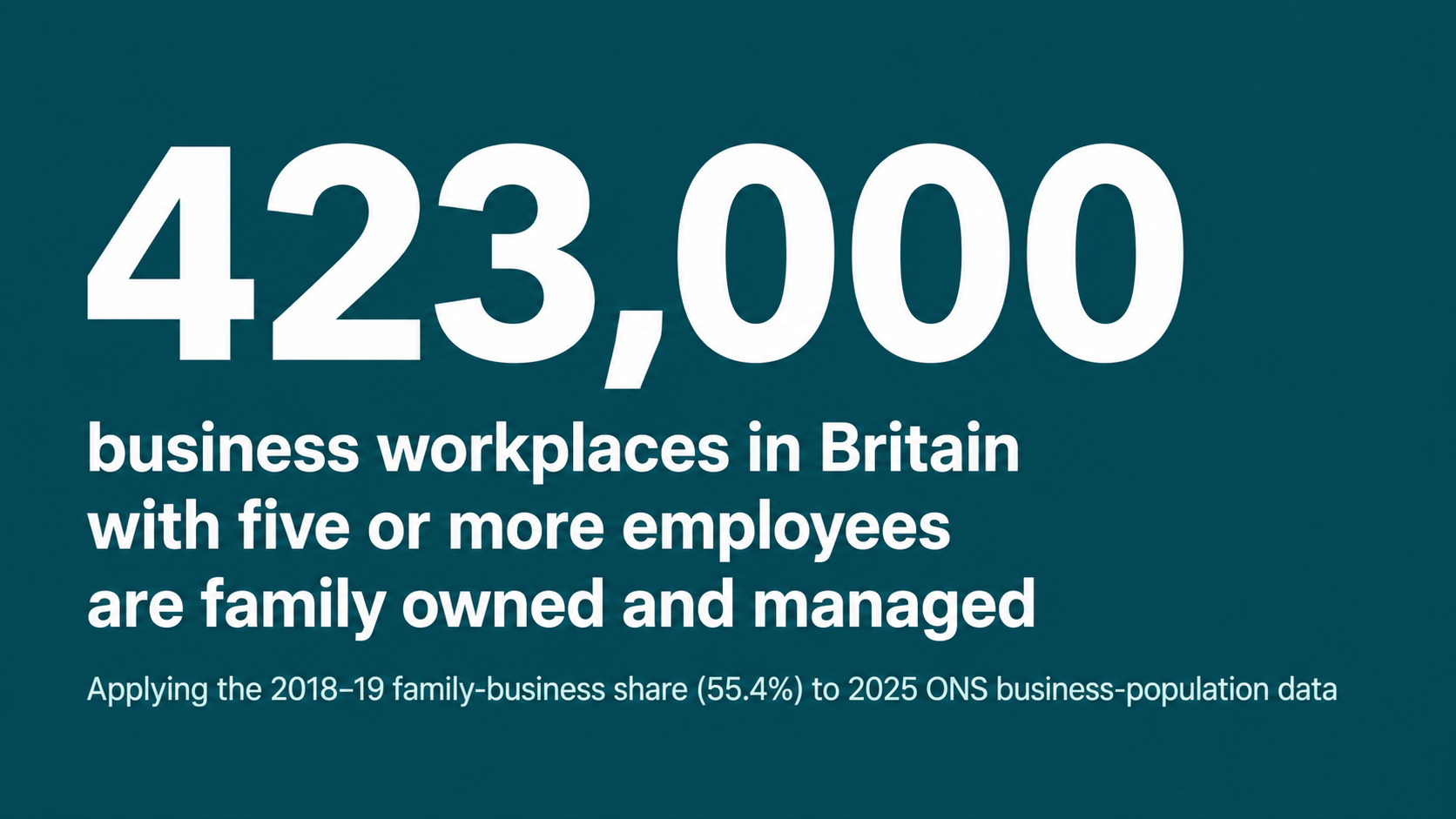
We estimate that around 423,000 private-sector, for-profit workplaces with five or more employees in Great Britain were family-business workplaces in 2025.[1]
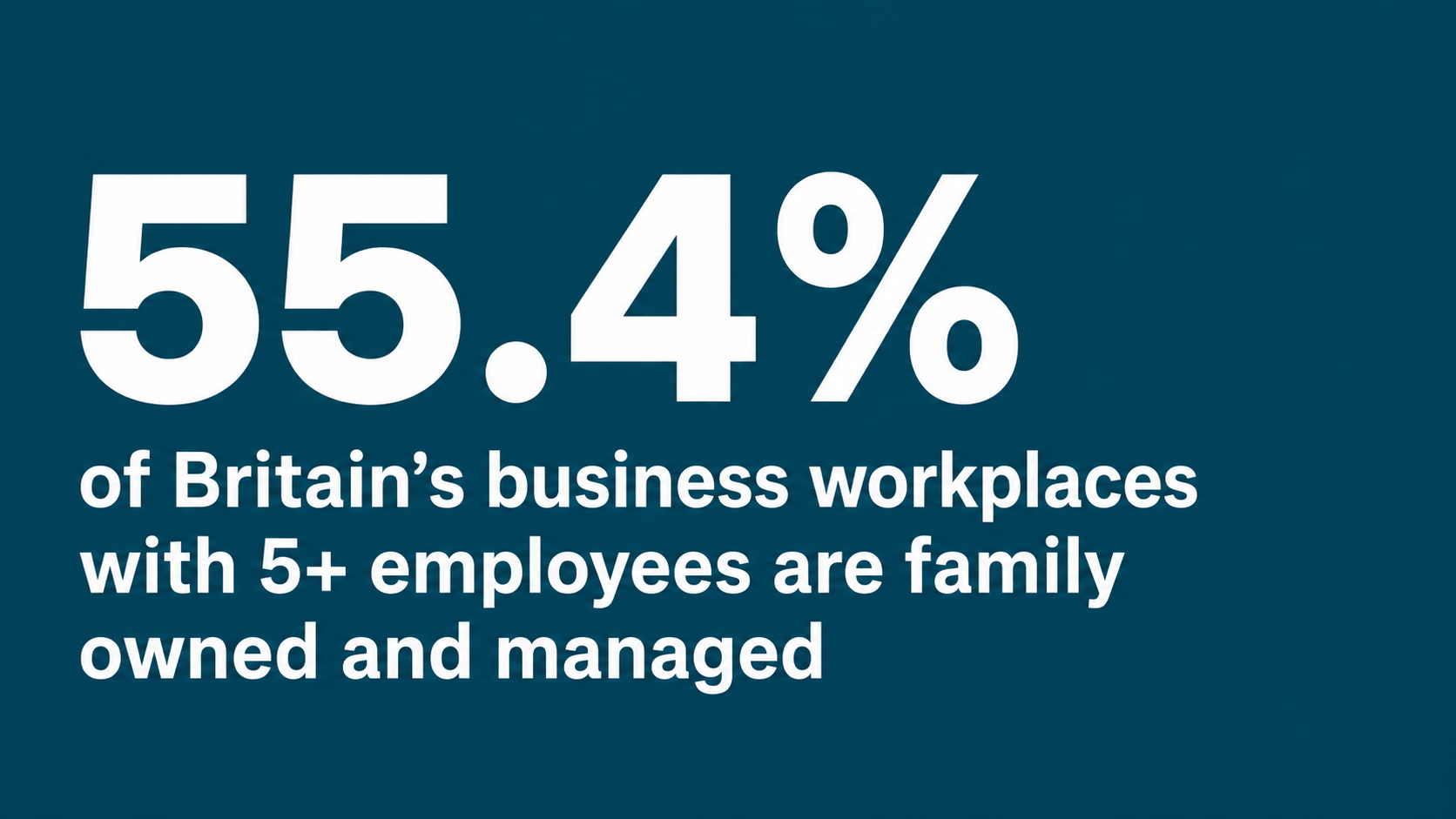
A majority of Britain's business workplaces are family owned and managed
The starting point is the UK government's Management and Wellbeing Practices Survey - a nationally representative survey of workplaces with five or more employees in Great Britain, carried out in 2018-19 by the National Institute of Economic and Social Research and Kantar Public. FBRF's analysis of 1,694 private-sector business workplaces in the survey found that 55.4% were family-business workplaces: that is, their businesses were majority owned by the founder or founding family, and the founder or family was actively involved in day-to-day management. That means family-business workplaces make up just over half of Britain's business workplaces with five or more employees - not a niche group.[2]
Where family-business workplaces are concentrated
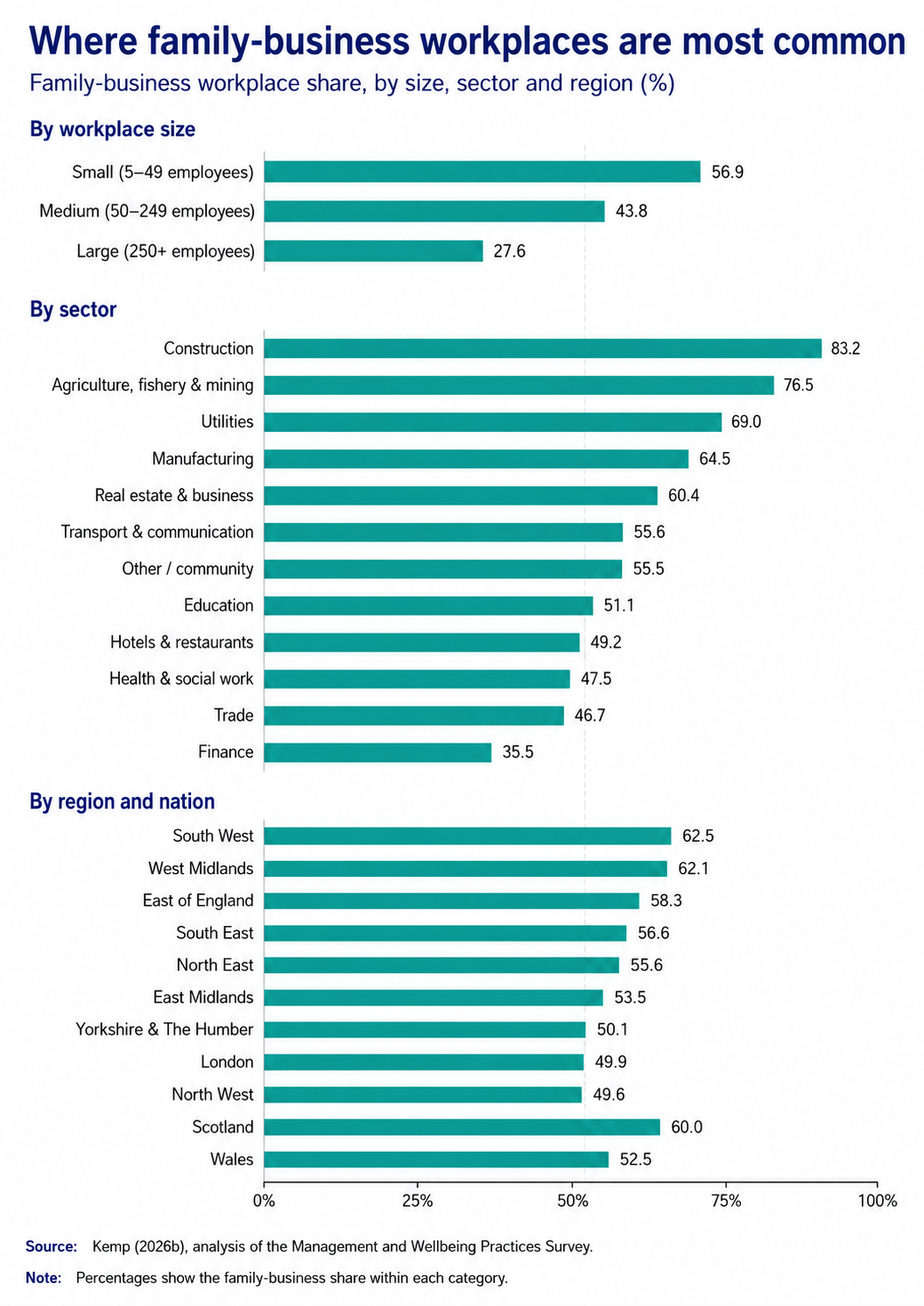
Family-business workplaces in Britain are unevenly distributed. Their share falls steeply with workplace size - from 57% of small workplaces with 5-49 employees to 44% of medium-sized workplaces and 28% of large workplaces. They also vary widely by sector, from 83% in construction and 77% in agriculture, fishing and mining down to 47% in trade and 36% in finance. Regional differences are more modest, though family-business workplaces are somewhat more common in the South West, the West Midlands and Scotland, and least common in London and the North West.
They are also structurally distinct: family-business workplaces are more likely to be single, independent sites, are smaller on average - 21 employees versus 29 in non-family workplaces - and have lower average shares of employees who are female, part-time, or from a non-white ethnic group.
They also tend to be run differently: they are less likely to use written policies, formal consultations and recognised unions, and respondents in family owned and managed workplaces are more likely to express a strong preference for consulting employees directly rather than through unions.
How many family-business workplaces does Britain have today?
The 55.4% share is a useful benchmark, but it comes from 2018–19. To estimate the number of family-business workplaces in 2025, we apply that survey share to the latest official count of business workplaces from ONS UK Business Counts, the official business register based on the Inter-Departmental Business Register, accessed through Nomis.[3]
To keep the estimate aligned with the Management and Wellbeing Practices Survey, we count private-sector, for-profit workplaces in Great Britain with five or more employees. This yields a base of 763,005 business workplaces in Great Britain in 2025. Applying the 55.4% family-business share gives us an estimate of about 423,000 family-business workplaces in 2025.[4]
This assumes that the family-business share has remained broadly stable since 2018–19. The best external check is the Longitudinal Small Business Survey - analysis by the FBRF indicates that over the past few years there has been fluctuation around a broadly stable level. On that basis, we make no upward or downward adjustment to the 55.4% figure.
Most are small workplaces
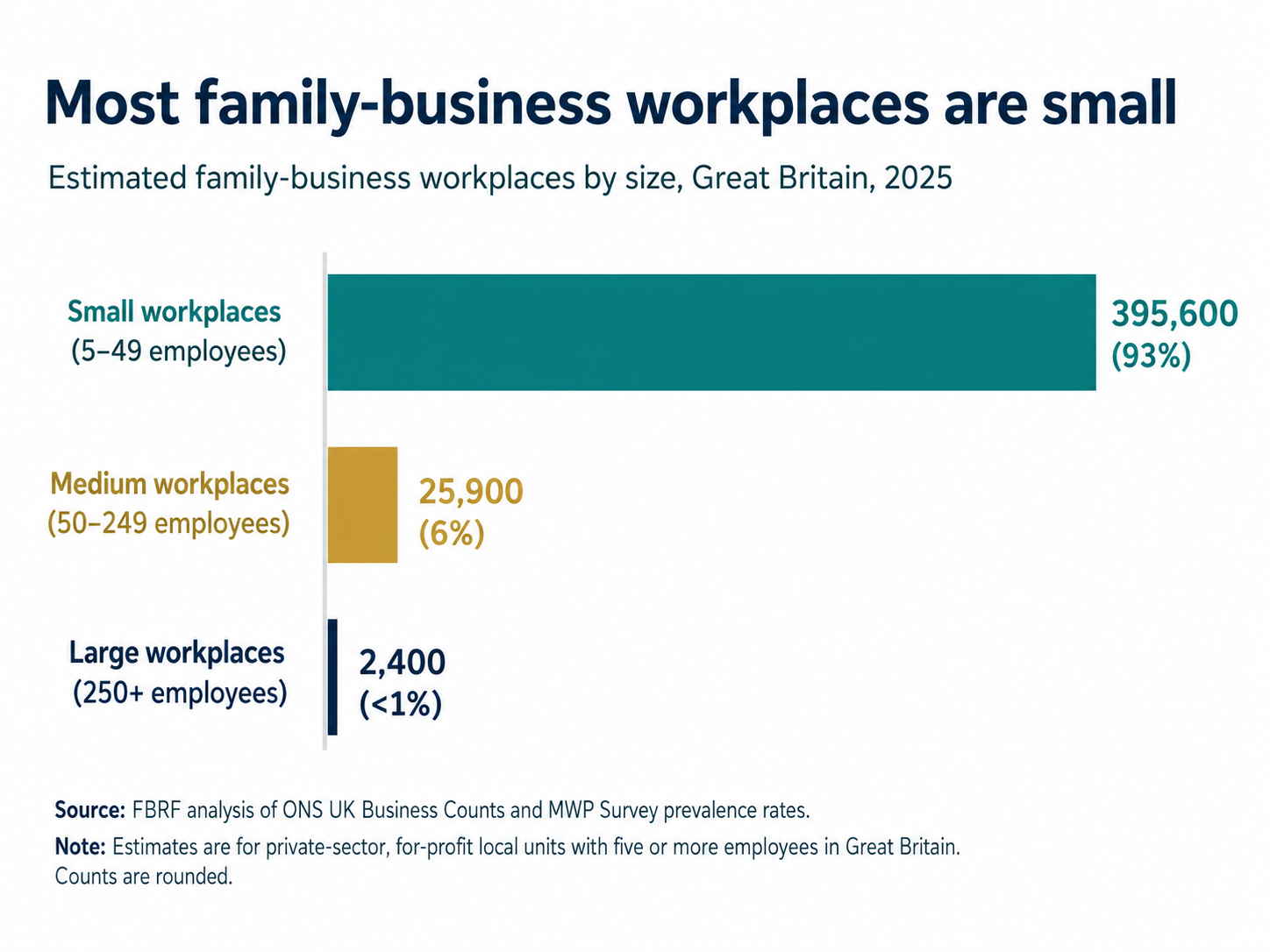
The estimate is heavily concentrated among small workplaces. Around 93% of estimated family-business workplaces with five or more employees have 5–49 employees. This mainly reflects the structure of the business-workplace population: most workplaces with five or more employees are small. The pattern is reinforced by the survey finding that family-business prevalence is higher among small workplaces and lower among large ones.
Why workplaces matter for policy
The Employment Rights Act 2025 and the government’s wider Make Work Pay programme represent a substantial package of labour-market reforms affecting employment law in Great Britain. The Act includes measures relating to zero-hours contracts, statutory sick pay, paternity leave and unpaid parental leave, flexible working, bereavement leave, harassment prevention, trade union rights and enforcement through the new Fair Work Agency. Some changes have already taken effect, while others are due to be implemented during 2026 and 2027.
For successful delivery of these reforms, the test will be how well they work out in real workplaces. Many of the changes depend on employers communicating rights clearly, handling requests consistently, consulting workers where required and documenting decisions.
Yet while many of the reforms place greater emphasis on clear policies, processes, consultation and documentation, while family-business workplaces are less likely to use written policies and formal consultation structures, even when workplaces of the same size are compared.
This matters because family-business workplaces are not a niche part of the British economy. Our estimate suggests that Great Britain has around 423,000 private-sector, for-profit family-business workplaces with five or more employees. Most are small workplaces, and many are single, independent sites. But the issue is not just size. Our research shows that, even when workplaces of the same size are compared, family-business workplaces are less likely to use some formal workplace structures and policies.
DBT’s own economic assessment of the Employment Rights Act points to some of these delivery challenges. The assessment states that businesses may benefit from the Act by increased employee productivity, greater use of flexible working, improved industrial relations and employee well-being. It also states that “the burdens placed on business represent a direct benefit to workers”, especially those in insecure and low-paid jobs.[5] Nonetheless, it also notes that “small and micro businesses are likely to be disproportionately impacted by the Act, while medium and large-sized businesses, despite employing more people, benefit from economies of scale and dedicated HR resourcing, meaning they are likely to experience a lower marginal cost per employee for each policy change”.[6]
In our analysis of data from the Management and Wellbeing Practices Survey, we found that family-business workplaces were less likely to report written flexible-working policies, formal consultation arrangements and recognised trade unions. They were also less likely to report some forms of formal family-related provision, such as enhanced maternity pay and formal bereavement policies. These patterns do not necessarily mean that family-business workplaces are less supportive of their employees. They point instead to a different way of working: less reliant on written policies and formal structures, and more included towards direct consultation.
The question for policymakers is therefore whether the implementation of the government’s package of labour-market reforms takes this reality sufficiently into account. Will small and family-run workplaces have the capacity, information and practical support they need to apply the new rules consistently? Will these reforms work for businesses without dedicated HR teams or the organisational structures, resources and expertise that larger employers may have? And where reforms require formal consultation, written procedures or clear channels for worker representation, how will those expectations translate into workplaces that are less likely to have formal HR systems and structures?
For family businesses, the challenge is practical. Direct, relationship-based management can be valuable, especially where owners and employees know each other well. But as legal rights become more detailed and expectations around consultation, documentation and consistency increase, relying only on informal practices may become more difficult. Family businesses do not need a separate compliance regime. However, if the government’s labour-market agenda is to achieve its aims, it needs to recognise how such businesses work in practice.
Notes
[1] This estimate covers private-sector, for-profit workplaces with five or more employees in Great Britain. It is not a count of all family businesses or all family-business workplaces, because the MWP survey did not cover workplaces with fewer than five employees.
[2] The MWP survey was carried out in 2018–19 and is nationally representative of workplaces with five or more employees in Great Britain. In this analysis, a family-business workplace means a workplace belonging to a business that is majority founder-/family-owned and founder-/family-managed. Full details of the family-business analysis are available in the FBRF working paper; details of the survey design, sampling and methodology are available in the MWP Survey technical report.
[3] The 2025 estimate applies the 55.4% family-business share from the MWP survey analysis to the latest comparable count of business workplaces from ONS UK Business Counts. The base is restricted to companies, sole proprietors and partnerships with five or more employees in Great Britain.
[4] The 55.4% figure is a survey estimate, so the 423,000 figure should be read as a central estimate rather than a precise count. Allowing for survey uncertainty, the likely range is roughly 400,000–446,000.
[5] DBT (2026) Employment Rights Act 2025: Economic Analysis; p.23-26.
[6] DBT (2026) Employment Rights Act 2025: Economic Analysis; p.32.
Sources
Acas (2026) Employment Rights Act 2025. https://www.acas.org.uk/employment-rights-act-2025
Bacon, N., Hoque, K. and Siebert, S. (2013) Family Business People Capital. London: IFB Research Foundation. https://www.bayes.citystgeorges.ac.uk/__data/assets/pdf_file/0014/180050/People-Capital.pdf
Department for Business and Trade (2023a) Findings from the Management and Wellbeing Practices Survey. London: DBT. https://niesr.ac.uk/wp-content/uploads/2023/06/Findings-from-the-Management-and-Wellbeing-Practices-Survey-1.pdf
Department for Business and Trade (2023b) Management and Wellbeing Practices Survey 2018: Technical Report. London: DBT. https://doc.ukdataservice.ac.uk/doc/9253/mrdoc/pdf/9253_mwp_technical_report_final_clean_external.pdf
Department for Business and Trade (2025) Longitudinal Small Business Survey 2024: SME Employers. London: DBT. https://www.gov.uk/government/statistics/small-business-survey-2024-businesses-with-employees
Department for Business and Trade (2026) Make Work Pay. https://www.gov.uk/government/collections/make-work-pay
Department for Business and Trade (2026) Make Work Pay: consultation on improving access to flexible working. https://www.gov.uk/government/consultations/make-work-pay-improving-access-to-flexible-working
Department for Business and Trade (2026) Employment Rights Act 2025: overview factsheet. https://assets.publishing.service.gov.uk/media/696fabb3c0f4afaa9536a0f2/employment-rights-act-2025-overview-factsheet.pdf
Department for Business and Trade (2026) Plan to Make Work Pay and Employment Rights Act: timeline update. https://www.gov.uk/government/publications/implementing-the-plan-to-make-work-pay-and-employment-rights-act/plan-to-make-work-pay-and-employment-rights-act-timeline-update
Department for Business and Trade and Department for Work and Pensions (2025) Parental leave and pay review: call for evidence. https://www.gov.uk/government/calls-for-evidence/parental-leave-and-pay-review-call-for-evidence/parental-leave-and-pay-review-call-for-evidence
Department for Business and Trade (2026) Employment Rights Act 2025: Economic Analysis. London: DBT. https://assets.publishing.service.gov.uk/media/695d3ebfbd1c076f787e7399/employment-rights-act-2025-economic-analysis.pdf
Kemp, M. (2024) How common are family businesses? Evidence from the Longitudinal Small Business Survey 2023. London: Family Business Research Foundation. https://www.fbrf.org.uk/how-common-are-family-firms
Kemp, M. (2026a) Family SMEs in the UK: Latest findings from the Small Business Survey 2024. London: Family Business Research Foundation. https://www.fbrf.org.uk/familysmes-2024
Kemp, M. (2026b) Management and wellbeing practices in family-business workplaces in Britain. FBRF Working Paper. London: Family Business Research Foundation. https://www.fbrf.org.uk/reports/family-business-workplaces-in-britain
Kemp, M. (2026c) Management and wellbeing practices in family-business workplaces in Britain. FBRF Research and Policy Briefing No. 8. London: Family Business Research Foundation. https://www.fbrf.org.uk/research-briefings/family-business-workplaces
Office for National Statistics (2025) UK business; activity, size and location: 2025. Newport: ONS. https://www.ons.gov.uk/businessindustryandtrade/business/activitysizeandlocation/bulletins/ukbusinessactivitysizeandlocation/2025
Office for National Statistics / Nomis (2025) UK Business Counts: local units by industry and employment size band. https://www.nomisweb.co.uk/datasets/idbrlu
UK Parliament (2025) Employment Rights Act 2025. https://bills.parliament.uk/bills/3737
The National Archives / legislation.gov.uk (2025) Employment Rights Act 2025. https://www.legislation.gov.uk/ukpga/2025/36