
The effects of family ownership: an integrated framework for research and practice
Research and Policy Briefing no.7
Martin Kemp, Family Business Research Foundation
March 2026
Summary
This research briefing introduces an evidence-based framework for understanding the effects of family ownership on businesses, business-owning families, and the wider economy and society. Drawing on an AI-assisted review of the family-business literature, the analysis identified 56 distinct effects of family ownership, which were grouped into six domains: internal business effects; economic effects; social and community impact; family dynamics and individual effects; stakeholder and institutional effects; and integrated effects.
The framework provides a structured way of organising evidence in the family-business field and of understanding where and how family ownership has an effect. It shows that family ownership can generate long-term orientation, continuity, trust and wider social and economic value, but it can also create tensions and challenges, particularly in relation to governance, succession, fairness and interpersonal dynamics.
By clarifying the different domains in which family ownership matters — and the way those domains can overlap — the framework can support future research, improve policy analysis, and help practitioners better understand the distinctive opportunities and challenges associated with family firms.
1. Introduction
Family business research has identified many ways in which family ownership can shape the operation of firms, the experiences of business-owning families, and the contribution that family firms make to the wider economy and society. Yet these effects are often discussed separately, making it harder to see the broader pattern. This research briefing brings those different strands together by setting out an integrated framework for understanding the effects of family ownership.
The briefing identifies and classifies the effects of family ownership by drawing on an AI-assisted review of research and evidence in the family-business field. The resulting framework is intended as a practical tool for organising evidence, planning future research and assessing the impacts of family ownership.
2. The integrated framework
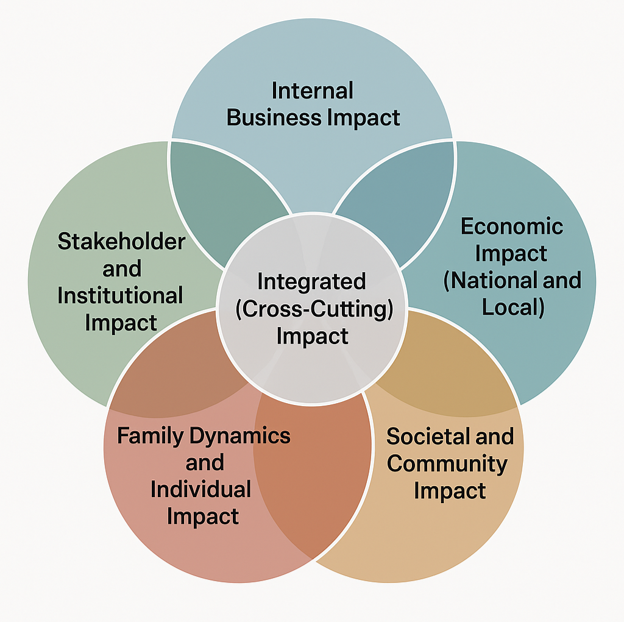
A systematic AI-assisted search and analysis of a large sample of the international family-business research literature was carried out to identify the multiple and often complex effects of family ownership on family businesses, business-owning families and their communities. An analysis of this sample identified 56 distinct effects of family ownership. These were then classified and clustered into six higher-level domains. Five of these represent distinct areas in which family ownership can have an effect: internal business effects; economic effects; social and community impact; family dynamics and individual effects; and stakeholder and institutional effects. The sixth domain — integrated effects — captures the overlap between the other five domains, where effects interact, reinforce one another, or create tensions and trade-offs.
Figure 1 presents this framework schematically. The overlapping centre of the diagram reflects the integrated nature of family ownership: its effects rarely occur in isolation and often cascade across internal and external dimensions at the same time. The framework therefore provides a way of analysing not only individual effects, but also the relationships between them.
Figure 1. Mapping the effects of family ownership
Source: Author’s AI-assisted analysis of the family-business literature.
The remainder of this briefing examines each of these domains in turn, beginning with the internal business effects of family ownership and then moving outwards to consider its economic, social, family, stakeholder and integrated effects.
3. Internal business effects
This domain concerns the internal effects of family ownership on the business itself – how it is governed, led, organised, and sustained across generations.
Family ownership can influence the way a business is governed, managed, and operated. Family businesses often develop distinctive governance arrangements and a stronger long-term orientation, as business-owning families seek continuity, stewardship, and transgenerational success (Howorth and Kemp, 2019; Binz Astrachan and Botero, 2021; Clinton et al., 2018).
Family involvement can also influence leadership and decision-making. Many family firms combine family leadership with non-family executives or directors, which can strengthen accountability and strategic discipline when roles are clearly defined (IFB Research Foundation, 2019a; 2019b).
Family firms can also build strong organisational cultures and high levels of employee loyalty. However, the same family dynamics that support continuity can sometimes make it harder to recruit, retain, and empower non-family talent if responsibilities, reporting lines or promotion routes are unclear (IFB Research Foundation, 2019a).
"Family ownership may also support entrepreneurship and a long-term approach to innovation, helping firms adapt and renew over time, although a strong preference for continuity and control can sometimes make change more cautious or incremental (Wright et al., 2016; Clinton et al., 2018).
4. Economic effects
This domain concerns the contribution that family-owned firms make to the wider economy beyond the individual business itself. It includes their effects on turnover, value added, employment, household incomes and tax revenues.
In the UK, family businesses generated £2.8 trillion in turnover in 2023, produced £985 billion in gross value added (GVA), and supported 15.8 million jobs, underlining their importance to national output and employment (Cebr, 2025; Kemp, 2025c). They also paid an estimated £401 billion in employee compensation, showing that their economic contribution extends beyond firm performance to household incomes and spending power across the economy (Cebr, 2025; Kemp, 2025c). The same analysis estimates that family firms contributed £422 billion in total taxes to the UK Exchequer in 2023, demonstrating their importance to the public finances as well as to private-sector activity (Cebr, 2025; Kemp, 2025c).
These economic effects are felt across the UK, but not evenly. Family firms are especially important in some regions and sectors: FBRF’s latest sector analysis highlights their particularly strong presence in Wales and Northern Ireland and shows that they make major contributions in sectors such as construction, wholesale and retail, and professional services (Cebr, 2025). The wider economic role of family firms therefore includes not only national output and tax revenues, but also their importance to regional economies, local employment and sectoral activity across the UK.
5. Social and community impact
This domain concerns the effects of family ownership beyond the firm itself, on communities, society, and the environment. Research suggests that family ownership can shape how businesses relate to their communities. For example, Litz and Stewart (2000) studied more than 300 small U.S. hardware stores and compared firms according to the extent of family involvement in ownership and management, and the intention to keep the business in the family. They found that family firms reported higher levels of community involvement than non-family firms, particularly in charitable, service and youth-related activities (Litz and Stewart, 2000). More recent UK research commissioned by Glover and Trehan (2020) shows that family firms often engage locally through charitable donations, volunteering, community leadership, support for young people, inclusive employment practices, and partnerships with schools, charities, local government, and grassroots organisations.
Philanthropy is a key part of this wider social impact. Beth Breeze’s study of family business philanthropy found that giving is often localised, values-driven and linked to stewardship, and may involve time, products, employee effort and family or business foundations as well as money. The same study suggests that philanthropy can also reinforce family cohesion and help families build a lasting local legacy (Breeze, 2009).
In recent years, socially responsible business practices have been increasingly framed in terms of ESG — Environmental, Social and Governance. Recent FBRF work on ESG argues that family firms may be well placed to embed sustainability and social responsibility in their activities because of their long-term orientation, family values, and community ties, although adoption remains uneven and smaller firms often face practical resource constraints (Hughes et al., 2024; 2025).
6. Family dynamics and individual effects
This domain concerns the effects of family ownership on the owning family and on individual family members, including identity, belonging, succession, fairness, and intergenerational relationships.
Family ownership can create strong emotional ownership — a sense that the business matters personally, forms part of an individual’s identity and connects them to both past and future generations. However, this feeling of connection can be weakened by exclusion or badly managed conflict (Björnberg and Nicholson, 2008; Nicholson and Björnberg, 2007).
Research suggests that next-generation engagement cannot be taken for granted: it has to be cultivated intentionally through education, open communication, and meaningful involvement in the family business, in governance and decision-making (Howorth et al., 2016; Binz Astrachan and Botero, 2021).
Succession is one of the most important family-level effects of family ownership. It can preserve continuity, values, and legacy, but it is also a major transition that can expose or intensify family tensions around timing, roles and willingness to lead. Research shows that family succession often stalls, not because of a lack of heirs, but due to strained relationships, unwillingness or uncertainty among potential successors, and wider business or market pressures (De Massis et al., 2008; Nicholson and Björnberg, 2007).
The transfer of ownership and wealth from one generation to the next can create further strain if family members perceive decisions to be unfair. Recent guidance from the FBRF highlights recurring dilemmas that can arise during the intergenerational transfer of a family business — for example, between fairness and merit, and between preferences for insider or outsider ownership. Such transitions can be managed more effectively when transparent agreements and family-governance structures are in place — such as family councils or constitutions — which can help to reduce misunderstanding and conflict (Lanz and Kemp, 2023; Kemp and Lanz, 2024; Binz Astrachan and Botero, 2021).
7. Stakeholder and institutional effects
This domain concerns the effects of family ownership on a firm’s relationships with external stakeholders and on the institutional environment in which it operates. It therefore includes both the way family firms are perceived by customers, employees, suppliers, investors and regulators, and the way public institutions, government policies, regulatory and governance frameworks shape the environment in which family firms operate.
Family ownership can influence how customers, employees, suppliers and other external stakeholders view a business. Family firms are often seen as more trustworthy, authentic and long-term oriented than non-family firms, although family involvement can also raise concerns about nepotism, opacity or resistance to change among some audiences (Binz Astrachan, 2021).This wider trust premium is reflected in the 2024 Edelman Trust Barometer, which reported that family-owned businesses were the most trusted type of business globally compared with publicly traded corporations, state-owned enterprises, and non-family privately held companies (Edelman, 2024).
Government policy and governance frameworks also fall within this domain. In the UK, the Wates Corporate Governance Principles for large private companies provide an apply-and-explain framework intended to help large private companies raise their standards of governance and reporting (FRC, 2018). FBRF’s study found that large family firms were slightly more likely than non-family firms to adopt the Wates Principles, and that, among firms using any governance code, family firms were especially likely to choose them. However, the report also shows that adoption does not mean uniformly stronger disclosure: while the overall pattern was broadly similar, family firms disclosed less than non-family firms on board composition and director accountability, even though they compared relatively well on stakeholder relationships and engagement (Kemp et al., 2024; Kemp, 2025a).
ESG is another clear example of stakeholder and institutional impact. The FBRF’s ESG report argues that family firms are operating in a fast-changing environment shaped by rising stakeholder expectations, expanding reporting frameworks and a regulatory agenda that is likely to extend well beyond the largest firms over time. It also suggests that family businesses may be well placed to respond because of their long-term orientation, legacy concerns and community ties, but warns that this advantage depends on being able to integrate ESG into strategy, collect credible data and communicate a convincing ESG story to stakeholders (Hughes et al., 2024; Hughes et al., 2025).
Tax policy provides a further example of stakeholder and institutional impact. The FBRF’s report on Business Property Relief (BPR) examines how inheritance-tax rules shape the environment in which family businesses plan for succession, ownership continuity and long-term investment. The reforms announced by the UK government in October 2024, due to take effect from April 2026, represent the most significant tightening of BPR in decades. Most smaller estates are expected to remain outside their scope, with exposure concentrated among larger estates with substantial business, agricultural or unlisted shareholdings. The report also examines the political response to the reforms and why they have proved so controversial. At the heart of the debate are two competing policy narratives: one emphasising fairness and fiscal sustainability, the other continuity, investment and the benefits of family ownership (Kemp, 2025b).
Family firms are not only shaped by institutions, government policy, and regulatory frameworks; family-business organisations can also act as institutional actors in their own right. By supporting representative bodies and membership organisations, family firms may seek to influence policy, shape public debate and strengthen understanding of the sector through the national and trade press and through social media.
8. Integrated effects
The above effects are not independent and can interact with, reinforce or counteract one another. This sixth and final domain captures what happens where the other five domains overlap. Family ownership rarely affects only one area at a time: the same values, governance choices and long-term objectives can shape business strategy, family relationships, stakeholder trust, and wider economic or social outcomes simultaneously.
Research on long-term thinking in UK family businesses, for example, shows that family firms often balance financial goals with non-economic aims such as continuity, perseverance and legacy, so strategic decisions are shaped by both business priorities and family purpose (Clinton et al., 2018).
Community engagement provides another example of this overlap: FBRF research suggests that strong family culture and local embeddedness can create reciprocal effects, with community involvement strengthening trust, reputation and identity while also benefiting the places in which family firms operate (Glover and Trehan, 2020).
Responsible ownership and family governance also have integrated effects. Shared values, ownership education, next-generation involvement and governance structures can help align family expectations with business decision-making and long-term continuity (IFB Research Foundation, 2019; Binz Astrachan and Botero, 2021).
ESG is another cross-cutting example: recent FBRF work argues that family firms may be well placed to connect sustainability, governance, stakeholder expectations and long-term legacy in a single strategic agenda, although adoption remains uneven and smaller firms often face practical constraints (Hughes et al., 2024; 2025).
Integrated effects therefore include both reinforcing effects and tensions. Strengths in one area can support another, but efforts to maintain family harmony or keep control within the family can sometimes slow leadership development, succession decisions, or changes in business strategy (IFB Research Foundation, 2019; Clinton et al., 2018).
Thinking about family ownership in this way helps show not only where it has an effect, but also how those effects interact across the business, the family and the wider economy and society.
References
Binz Astrachan, C. (2021) ‘Should You Brand Your Family Business? Evidence from Research and Practice’, FamilyBusiness.org, 21 June 2021. Available at: https://familybusiness.org/content/should-you-brand-your-family-business-evidence-from-research-and
Binz Astrachan, C. and Botero, I.C. (2021) Business Family Governance 2.0: Leveraging Business Family Governance for Family Business Continuity. London: IFB Research Foundation. Available at: https://www.fbrf.org.uk/s/ifb_rf_familygovernancereport_november2021_b.pdf
Björnberg, Å. and Nicholson, N. (2008) Emotional Ownership: The Critical Pathway Between the Next Generation and the Family Firm. London: Institute for Family Business (UK). Available at: https://www.fbrf.org.uk/reports/emotional-ownership
Breeze, B. (2009) Natural Philanthropists: Findings of the Family Business Philanthropy and Social Responsibility Inquiry. London: Institute for Family Business (UK). Available at: https://www.fbrf.org.uk/s/natphilanthropists_final.pdf
Centre for Economics and Business Research (Cebr) (2025) The State of the Nation: The UK Family Business Sector in 2023. London: Family Business Research Foundation. Available at: https://www.fbrf.org.uk/reports/state-of-the-nation-23
Clinton, E., Diaz-Moriana, V., Brophy, M. and Gamble, J.R. (2018) Long-Term Thinking in UK Family Business. An IFB Research Foundation Working Paper. London: IFB Research Foundation. Available at: https://www.fbrf.org.uk/s/long-term-thinking-in-family-business.pdf
De Massis, A., Chua, J.H. and Chrisman, J.J. (2008) ‘Factors Preventing Intra-Family Succession’, Family Business Review, 21(2), pp. 183–199. Available at: https://onlinelibrary.wiley.com/doi/epdf/10.1111/j.1741-6248.2008.00118.x
Edelman (2024) 2024 Edelman Trust Barometer. Available at: https://www.edelman.com/trust/2024/trust-barometer (Accessed: 16 March 2026).
Financial Reporting Council (FRC) (2018) The Wates Corporate Governance Principles for Large Private Companies. London: Financial Reporting Council. Available at: https://www.frc.org.uk/library/standards-codes-policy/corporate-governance/the-wates-corporate-governance-principles-for-large-private-companies/
Glover, J. and Trehan, K. (2020) Family Business and Community Engagement. London: IFB Research Foundation. Available at: https://www.fbrf.org.uk/reports/family-business-community-engagement
Howorth, C., Parkinson, C., Leitch, C. and Stead, V. (2016) Next Generation Engagement in UK Family Business. London: IFB Research Foundation. Available at: https://www.fbrf.org.uk/s/next-generation-engagement-in-uk-family-business.pdf
Howorth, C. and Kemp, M. (2019) Governance in Family Businesses: Evidence and Implications. London: IFB Research Foundation. Available at: https://www.fbrf.org.uk/s/governance-in-family-businesses-evidence-and-implications_web.pdf (Accessed: 16 March 2026)
Hughes, M., Hu, Q., Simeonova, B., Ge, B., Issah, B.W., Jack, S., Hughes, P. and Dai, S. (2024) ESG in Family Firms: A Review of Research, Regulations and Practice Guidance. London: Family Business Research Foundation. Available at: https://www.fbrf.org.uk/research-briefings/esg-in-family-firms
Hughes, M., Hu, Q., Simeonova, B., Ge, B., Issah, W.B., Jack, S., Hughes, P., Dai, S., and Kemp, M. (2025) ‘ESG essentials for family firms’, FamilyBusiness.org, 2 April. Available at: https://familybusiness.org/content/esg-essentials-for-family-firms
IFB Research Foundation (2019a) Maximizing People Capital. Family Business Challenges, No. 16. Available at: https://www.fbrf.org.uk/s/maximizing-people-capital-web.pdf
IFB Research Foundation (2019b) Professionalising the Board. Family Business Challenges, No. 10. Available at: https://www.fbrf.org.uk/s/professionalising-the-board-web.pdf
IFB Research Foundation (2019c) Fostering Responsible Ownership. Family Business Challenges, No. 8. London: IFB Research Foundation. Available at: https://www.fbrf.org.uk/s/fostering-responsible-ownership-web.pdf (Accessed: 16 March 2026).
Kemp, M. (2025a) ‘Applying the Wates Principles in family firms’, Insights and Commentary, Family Business Research Foundation, 13 June. Available at: https://www.fbrf.org.uk/articles/applying-the-wates-principles-in-family-firms
Kemp, M. (2025b) Business Property Relief and Family Firms in the UK: From Relief to Reform. London: Family Business Research Foundation, 25 November. Available at: https://www.fbrf.org.uk/reports/bpr-relief-to-reform
Kemp, M. (2025c) ‘Family businesses have a massive impact on the UK economy’, FamilyBusiness.org, 28 February 2025. Available at: https://familybusiness.org/content/family-businesses-have-a-massive-impact-on-the-uk-economy
Kemp, M. (2025d) ‘It’s a family affair’, Governance and Compliance Magazine, July 2025. Available at: https://www.govcompmag.com/2025/07/28/its-family-affair
Kemp, M., Cuomo, F., Gaia, S., Baboukardos, D., Michelon, G. and Soobaroyen, T. (2024) Adoption of the Wates Principles among UK Family Businesses. London: Family Business Research Foundation. Available at: https://www.fbrf.org.uk/reports/adoption-of-the-wates-principles-among-uk-family-businesses
Kemp, M. and Hughes, M. (2025) ‘ESG in Family Firms’. FBRF Research and Policy Briefing No. 5, January 2025. Available at: https://www.fbrf.org.uk/s/FBRF_ESGreport_2024_Briefing-Version-v2.pdf
Kemp, M. and Lanz, S. (2024) ‘Transferring family wealth to the next generation: what’s fair?’, FamilyBusiness.org, 11 December. Available at: https://familybusiness.org/content/transferring-family-wealth-to-the-next-generation-whats-fair
Lanz, S. and Kemp, M. (2023) Business Family Justice in Ownership and Wealth Transfers. London: Family Business Research Foundation. Available at: https://www.fbrf.org.uk/s/28631_aston_familybusinesschallenges_guide19_aw_web.pdf
Litz, R.A. and Stewart, A.C. (2000) ‘Charity Begins at Home: Family Firms and Patterns of Community Involvement’, Nonprofit and Voluntary Sector Quarterly, 29(1), pp. 131–148. Available at: https://journals.sagepub.com/doi/10.1177/0899764000291008
Nicholson, N. and Björnberg, Å. (2007) Ready, Willing and Able? The NextGen in Family Business. London: Institute for Family Business (UK). Available at: https://www.fbrf.org.uk/reports/ready-willing-able
PwC (2023) The Total Tax Contribution of UK Family Businesses. London: IFB Research Foundation. Available at: https://www.fbrf.org.uk/reports/total-tax-contribution-of-uk-family-businesses
Wright, M., De Massis, A., Scholes, L., Hughes, M. and Kotlar, J. (2016) Family Business Entrepreneurship. London: IFB Research Foundation. Available at: https://www.fbrf.org.uk/s/ifbrf-entrepreneurship-report.pdf