
The effects of family ownership: a new framework for understanding family firms
By Martin Kemp, Family Business Research Foundation
Family ownership has effects that reach well beyond the business itself. A new FBRF framework shows the impact of family firms occurs across multiple domains, ranging from governance and succession to economic contribution, community engagement and policy.
Family business research has identified many ways in which family ownership can shape businesses, business-owning families and the wider economy and society. Yet these effects are often discussed separately, making it harder to see the bigger picture.
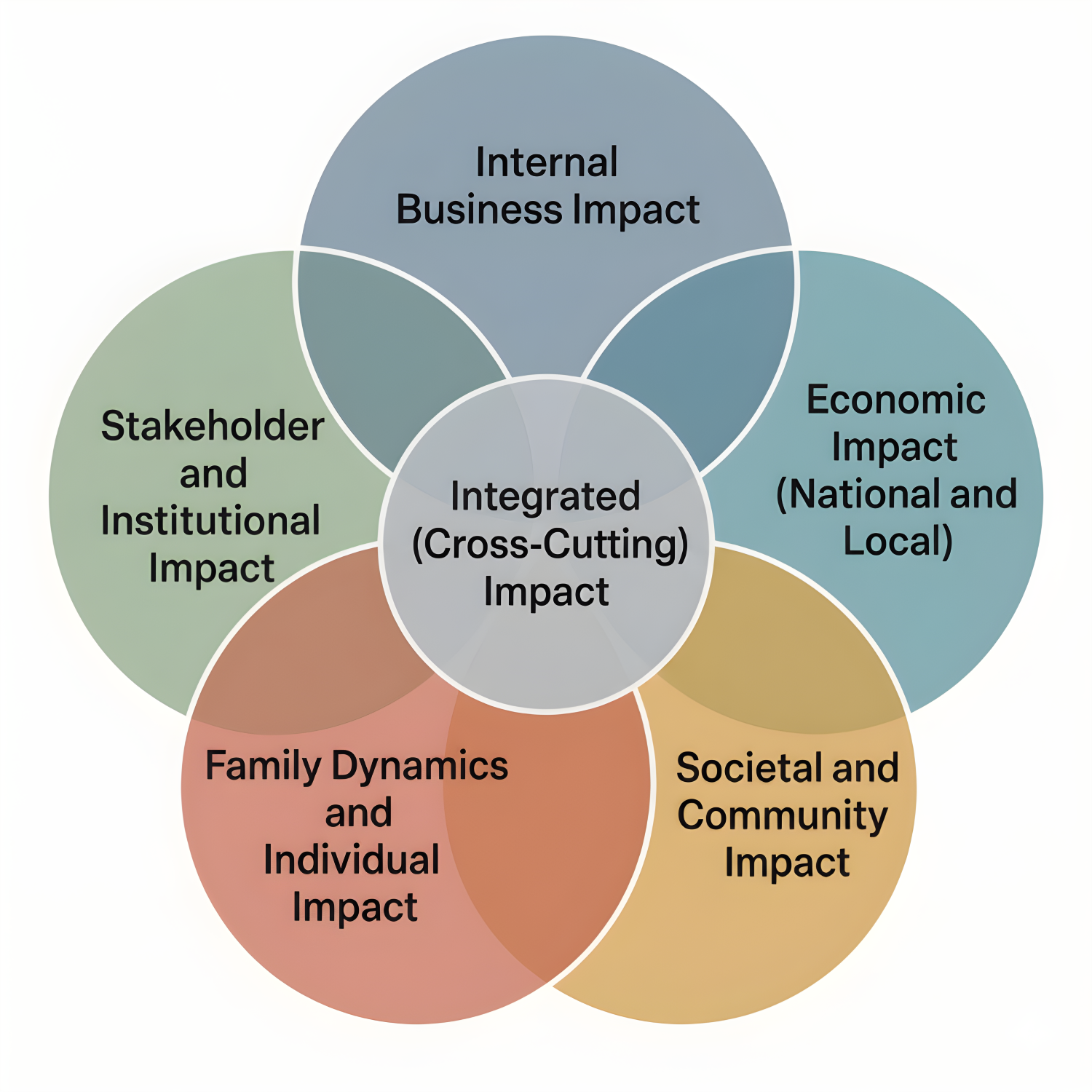
This article introduces an integrated framework that groups the effects of family ownership into six domains. Five of these capture distinct areas in which family ownership can have an effect: internal business effects; economic effects; social and community impact; family dynamics and individual effects; and stakeholder, institutional, and policy impacts. The sixth — integrated effects — captures the overlap between the other five, where effects reinforce one another or create tensions and trade-offs.
Figure 1 shows the effects framework schematically.
Figure 1. Mapping the effects of family ownership
© 2026 Family Business Research Foundation. All Rights Reserved.
Impact of family ownership on the business
Internal business effects concern how family ownership shapes the business itself — its governance, leadership, culture, values, strategy, and long-term direction. One of the clearest examples is governance. Research suggests that family firms often develop distinctive governance arrangements and a strong long-term orientation (Howorth and Kemp, 2019; Binz Astrachan and Botero, 2021; Clinton et al., 2018).
Economic impact
Economic effects concern the contribution that family businesses make to the wider economy through output, employment and tax revenues. In the UK, the latest FBRF/Cebr Family Business Sector Report estimates that family businesses generated £985 billion in gross value added and supported 15.8 million jobs in 2023, underlining their critical importance to the national economy as a whole (Cebr, 2025).
Social and community impact
Social and community impact concerns the effects of family ownership beyond the firm itself, on its communities, wider society and the environment. Research suggests that family ownership can shape how businesses relate to their communities; for example, in a study of more than 300 small hardware stores in the United States, Litz and Stewart found that family businesses reported higher levels of community involvement than non-family firms, particularly in charitable, service and youth-related activities (Litz and Stewart, 2000).
Impact on the business family and family members
Family dynamics and individual effects concern the impact of family ownership on the owning family, on individual family members, and the relationships between them. Succession is one of the clearest examples of this kind of effect. Research shows that family succession often stalls not because there is no heir, but because of strained relationships, uncertainty among potential successors or wider business pressures, illustrating how ownership of a business can have an impact family relationships as well as business continuity (De Massis et al., 2008; Nicholson and Björnberg, 2007).
Stakeholder and institutional effects
Stakeholder and institutional effects concern how family firms are shaped by external governance frameworks and regulation, public policies and the wider institutional environment in which they operate. A clear example from the UK is the Wates Principles, which provide a governance framework for large private companies in the UK (FRC, 2018). FBRF’s research found that large family firms were slightly more likely than non-family firms to adopt the Wates Principles, and identified differences between family and non family firms in their disclosures and governance practices (Kemp et al., 2024; Kemp, 2025a).
Integrated effects
Integrated effects capture what happens where the other five domains overlap. Family ownership rarely affects only one area at a time. Research on long-term thinking in UK family businesses, for example, shows that firms often balance financial goals with non-economic priorities such as continuity, perseverance and legacy, so that strategy is shaped by a mix of business priorities and family purpose (Clinton et al., 2018).
Taken together, these six domains show that the effects of family ownership extend well beyond the business itself. Family ownership can shape how firms are governed, how families manage succession, how businesses engage with and relate to their communities, and how they are both affected by and respond to government policies. Looking at family firms through this wider lens provides a framework for understanding the effect of family involvement in business on families, communities, the wider economy and society.
Read more: for a fuller discussion of the framework and the evidence behind it, see FBRF Research Briefing Paper no.7, The effects of family ownership: an integrated framework for research and practice.
References
Binz Astrachan, C. and Botero, I.C. (2021) Business Family Governance 2.0: Leveraging Business Family Governance for Family Business Continuity. London: IFB Research Foundation. Available at: https://www.fbrf.org.uk/reports/business-family-governance-2
Centre for Economics and Business Research (Cebr) (2025) The State of the Nation: The UK Family Business Sector in 2023. London: Family Business Research Foundation. Available at: https://www.fbrf.org.uk/reports/state-of-the-nation-23
Clinton, E., Diaz-Moriana, V., Brophy, M. and Gamble, J.R. (2018) Long-Term Thinking in UK Family Business. London: IFB Research Foundation. Available at: https://www.fbrf.org.uk/s/long-term-thinking-in-family-business.pdf
De Massis, A., Chua, J.H. and Chrisman, J.J. (2008) ‘Factors Preventing Intra-Family Succession’, Family Business Review, 21(2), pp. 183–199. Available at: https://onlinelibrary.wiley.com/doi/full/10.1111/j.1741-6248.2008.00118.x
Financial Reporting Council (FRC) (2018) The Wates Corporate Governance Principles for Large Private Companies. London: Financial Reporting Council. Available at: https://www.frc.org.uk/library/standards-codes-policy/corporate-governance/the-wates-corporate-governance-principles-for-large-private-companies/
Howorth, C. and Kemp, M. (2019) Governance in Family Businesses: Evidence and Implications. London: IFB Research Foundation. Available at: https://www.fbrf.org.uk/s/governance-in-family-businesses-evidence-and-implications_web.pdf
Kemp, M. (2025a) ‘Applying the Wates Principles in family firms’, Insights and Commentary, Family Business Research Foundation, 13 June. Available at: https://www.fbrf.org.uk/articles/applying-the-wates-principles-in-family-firms
Kemp, M., Cuomo, F., Gaia, S., Baboukardos, D., Michelon, G. and Soobaroyen, T. (2024) Adoption of the Wates Principles among UK Family Businesses. London: Family Business Research Foundation. Available at: https://www.fbrf.org.uk/reports/adoption-of-the-wates-principles-among-uk-family-businesses
Kemp, M. (2026) The effects of family ownership: an integrated framework for research and practice. FBRF Research and Policy Briefing No.7. Available at: https://www.fbrf.org.uk/research-briefings/the-effects-of-family-ownership-an-integrated-approach
Litz, R.A. and Stewart, A.C. (2000) ‘Charity Begins at Home: Family Firms and Patterns of Community Involvement’, Nonprofit and Voluntary Sector Quarterly, 29(1), pp. 131–148. Available at: https://journals.sagepub.com/doi/10.1177/0899764000291008
Nicholson, N. and Björnberg, Å. (2007) Ready, Willing and Able? The NextGen in Family Business. London: Institute for Family Business (UK). Available at: https://www.fbrf.org.uk/reports/ready-willing-able