
Why family-business workplaces matter for Britain’s labour-market reforms
By Martin Kemp, Family Business Research Foundation
July 2026
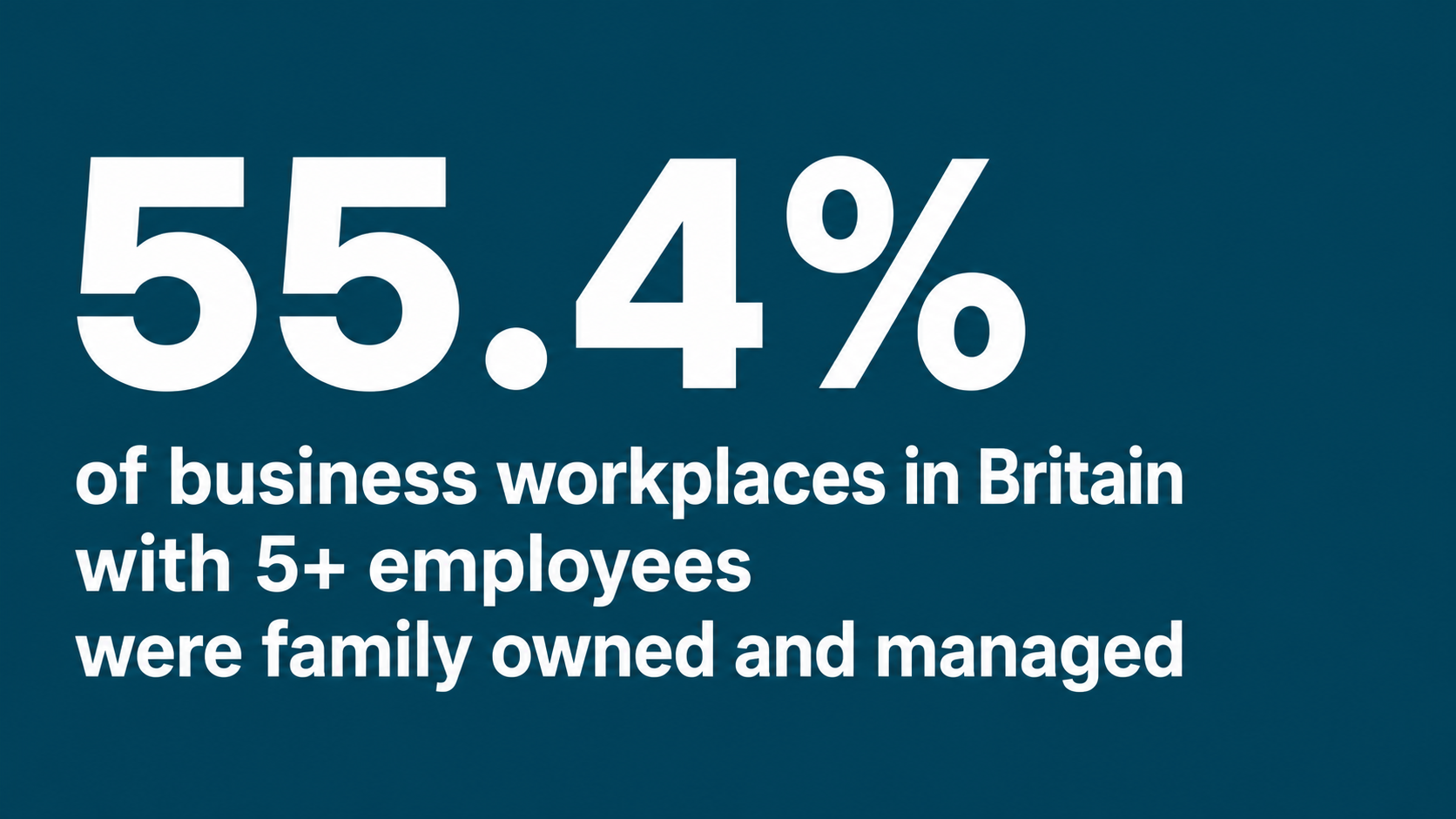
Family businesses are one of the largest - and least visible - parts of the British economy. They rarely show up as a distinct group in official statistics, which makes it hard to say how many there are or where they are. FBRF’s analysis of the UK Government’s 2018–19 Management and Wellbeing Practices Survey found that 55.4% of private-sector business workplaces with five or more employees were family owned and managed.[1] The research found important differences in how workplace practices were organised: family-business workplaces relied less on written policies and formal structures and showed a stronger preference for consulting employees directly. This article discusses the implications of these findings as the government implements the Employment Rights Act 2025 and its wider Make Work Pay programme.
What share of workplaces were family owned and managed?
The starting point is the UK Government's Management and Wellbeing Practices Survey - a nationally representative survey of workplaces with five or more employees in Great Britain, carried out in 2018-19 by the National Institute of Economic and Social Research and Kantar Public. FBRF's analysis of 1,694 private-sector business workplaces in the survey estimated that, on a weighted basis, 55.4% were family-business workplaces: that is, their businesses were majority owned by the founder or founding family, and the founder or family was actively involved in day-to-day management. That means family-business workplaces made up just over half of Britain's business workplaces with five or more employees - not a niche group.[2]
Where family-business workplaces were concentrated
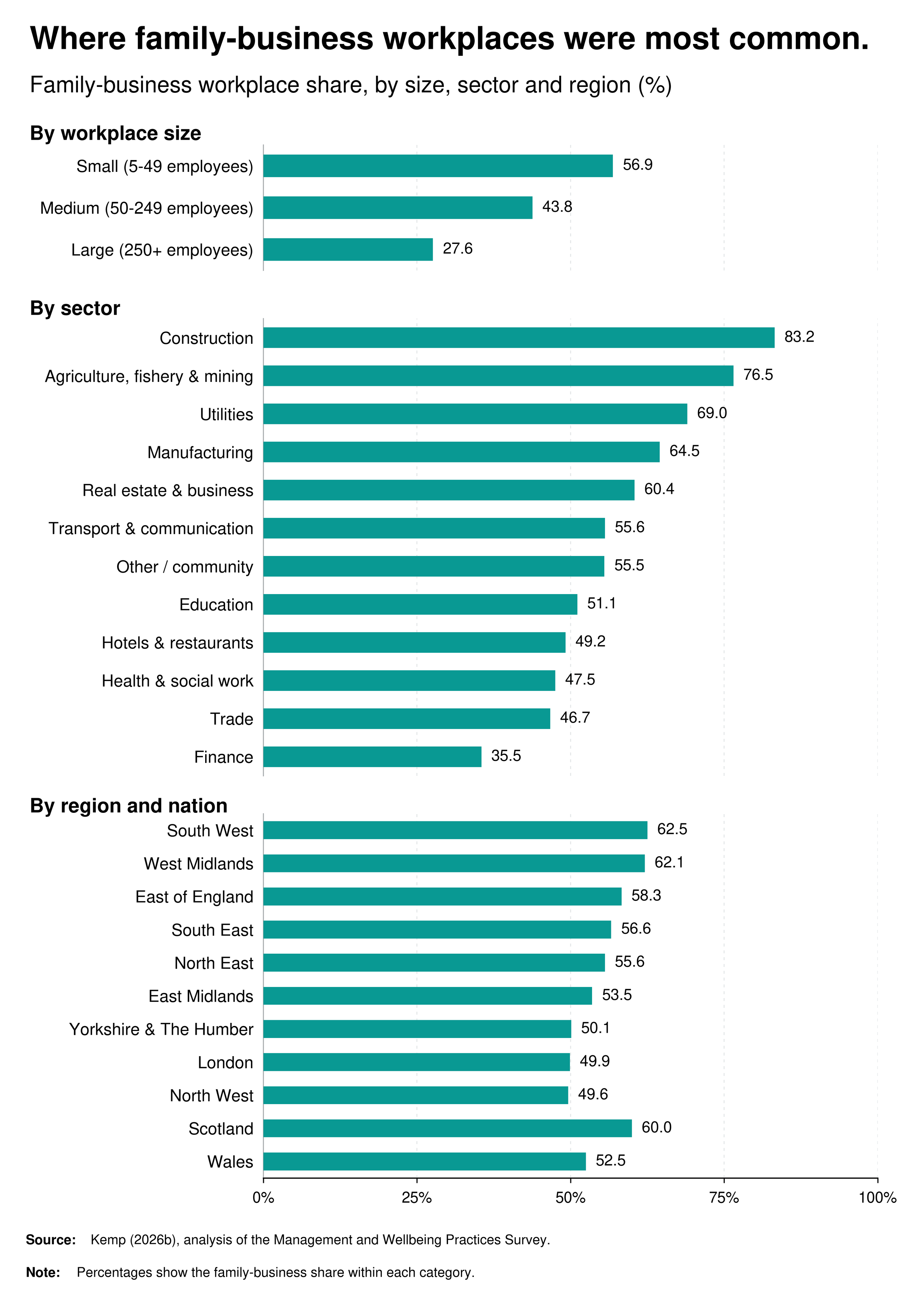
The prevalence of family-business workplacs varied by size, falling from 56.9% among small workplaces with 5–49 employees to 43.8% among medium-sized workplaces and 27.6% among large workplaces. Prevalence also varied by sector, from 83% in construction and 77% in agriculture, fishing and mining down to 47% in trade and 36% in finance. Regional differences were more modest, though family-business workplaces were somewhat more common in the South West, the West Midlands and Scotland, and were least common in London and the North West.
Family-business workplaces were also structurally distinct: they were more likely to be single, independent sites, were smaller on average — 21 employees compared with 29 in non-family workplaces — and had lower average shares of employees who were female, worked part-time or were from a non-white ethnic group. They also differed in how they were run: family-business workplaces were less likely to use written policies, formal consultation arrangements and recognised trade unions, while respondents in these workplaces were more likely to express a strong preference for consulting employees directly rather than through unions.
Why these workplace differences matter for policy
The Employment Rights Act 2025 and the government’s wider Make Work Pay programme represent a substantial package of labour-market reforms affecting employment law in Great Britain. The Act includes measures relating to zero-hours contracts, statutory sick pay, paternity leave and unpaid parental leave, flexible working, bereavement leave, harassment prevention, trade union rights and enforcement through the new Fair Work Agency.
The success of these reforms will depend on how well they work in real workplaces. Many of the changes depend on employers communicating rights clearly, handling requests consistently, consulting workers where required and documenting decisions.
Whilst the MWP Survey predates the current reforms, but its findings identify features of family-business workplaces that are directly relevant to their implementation. Many of the reforms place greater emphasis on clear policies, processes, consultation and documentation. Yet the MWP Survey showed that family-business workplaces were less likely to use written policies and formal consultation structures, even when workplaces of the same size were compared.
This matters because family-business workplaces accounted for more than half of private-sector business workplaces. Our analysis of data from the MWP Survey found that they were more likely than non-family workplaces to be small, single and independent sites. But the issue is not only size: even when workplaces of the same size were compared, family-business workplaces were less likely to use some formal workplace structures and written policies.
DBT’s own economic assessment of the Employment Rights Act points to some of these delivery challenges. The assessment identifies potential benefits for businesses, including higher employee productivity, greater use of flexible working, improved industrial relations and better employee wellbeing. It also states that “the burdens placed on business represent a direct benefit to workers”, especially those in insecure and low-paid jobs.[3] Nonetheless, it also notes that “small and micro businesses are likely to be disproportionately impacted by the Act, while medium and large-sized businesses, despite employing more people, benefit from economies of scale and dedicated HR resourcing, meaning they are likely to experience a lower marginal cost per employee for each policy change”.[3]
In our analysis of data from the Management and Wellbeing Practices Survey, we found that family-business workplaces were less likely to report written flexible-working policies, formal consultation arrangements and recognised trade unions. They were also less likely to report some forms of formal family-related provision, such as enhanced maternity pay and formal bereavement policies. These patterns do not necessarily mean that family-business workplaces are less supportive of their employees. The findings point instead to a different way of working: less reliance on written policies and formal structures, and a stronger preference for direct consultation with employees.
The question for policymakers is therefore whether the implementation of the government’s package of labour-market reforms takes this reality sufficiently into account. Will small and family-run workplaces have the capacity, information and practical support they need to apply the new rules consistently? Will these reforms work for businesses without dedicated HR teams or the organisational structures, resources and expertise that larger employers may have? And where reforms require formal consultation, written procedures or clear channels for worker representation, how will those expectations translate into workplaces that are less likely to have formal HR systems and structures?
For family businesses, the challenge is practical. Direct, relationship-based management can be valuable, especially where owners and employees know each other well. But as legal rights become more detailed and expectations around consultation, documentation and consistency increase, relying only on informal practices may become more difficult. Family businesses do not need a separate compliance regime. However, if the government’s labour-market agenda is to achieve its aims, it needs to recognise how such businesses work in practice.
Notes
[1] The MWP Survey was carried out in 2018–19 and is nationally representative of workplaces with five or more employees in Great Britain. FBRF’s analysis was restricted to 1,694 private-sector business workplaces with valid information on family ownership and management. A family-business workplace was defined as a workplace belonging to a business that was majority founder-/family-owned and in which the founder or family was actively involved in day-to-day management. The percentages reported are weighted survey estimates. Full details are available in the FBRF working paper; details of the survey design and sampling are available in the MWP Survey technical report.
[2] The MWP survey was carried out in 2018–19 and is nationally representative of workplaces with five or more employees in Great Britain. In this analysis, a family-business workplace means a workplace belonging to a business that is majority founder-/family-owned and founder-/family-managed. Full details of the family-business analysis are available in the FBRF working paper; details of the survey design, sampling and methodology are available in the MWP Survey technical report.
[3] Department for Business and Trade (2026), Employment Rights Act 2025: Economic Analysis, pp. 23–26 and 32.
Sources
Department for Business and Trade (2023a) Findings from the Management and Wellbeing Practices Survey. London: DBT. https://niesr.ac.uk/wp-content/uploads/2023/06/Findings-from-the-Management-and-Wellbeing-Practices-Survey-1.pdf
Department for Business and Trade (2023b) Management and Wellbeing Practices Survey 2018: Technical Report. London: DBT. https://doc.ukdataservice.ac.uk/doc/9253/mrdoc/pdf/9253_mwp_technical_report_final_clean_external.pdf
Department for Business and Trade (2026) Make Work Pay. https://www.gov.uk/government/collections/make-work-pay
Department for Business and Trade (2026) Employment Rights Act 2025: overview factsheet. https://assets.publishing.service.gov.uk/media/696fabb3c0f4afaa9536a0f2/employment-rights-act-2025-overview-factsheet.pdf
Department for Business and Trade (2026) Employment Rights Act 2025: Economic Analysis. London: DBT. https://assets.publishing.service.gov.uk/media/695d3ebfbd1c076f787e7399/employment-rights-act-2025-economic-analysis.pdf
Kemp, M. (2026b) Management and wellbeing practices in family-business workplaces in Britain. FBRF Working Paper. London: Family Business Research Foundation. https://www.fbrf.org.uk/reports/family-business-workplaces-in-britain
Kemp, M. (2026c) Management and wellbeing practices in family-business workplaces in Britain. FBRF Research and Policy Briefing No. 8. London: Family Business Research Foundation. https://www.fbrf.org.uk/research-briefings/family-business-workplaces
The National Archives / legislation.gov.uk (2025) Employment Rights Act 2025. https://www.legislation.gov.uk/ukpga/2025/36